TL;DR: You keep going back to dieting because a diet offers a plan, certainty, and hope at the exact moment weight fear, social pressure, or a rough week hits. It’s not weak willpower. It’s a learned habit with real triggers. You stop by spotting your trigger, asking what you actually want underneath the diet, and replacing the structure diets gave you with gentle boundaries that aren’t rules.
Why do I keep going back to dieting? If you’ve asked yourself that, you’re in good company.
A follower told me, “I’ve tried quitting dieting several times in the last few years, but I keep going back to it.” Another said, “Every week I think I’ll start Monday.” Sound familiar?
Here’s where I’m coming from. I started dieting at 19 and kept at it for about 15 years. Calorie counting hooked me the most, and at one point I became a Beachbody coach, which was basically a weight-loss coach lol. So I know the pull. I felt it again last year, and I wrote about that whole story here.
This post is about why the pull keeps happening and what actually helps you stop. It’s not about you being weak or doing it wrong.
Is Going Back To Dieting a Willpower Problem?
TL;DR: No. Going back to dieting is a habit built on years of hearing that your body is a problem to fix. Diets also work for a while, which keeps you coming back. Willpower isn’t the missing piece.
Let’s be real. Diets often do something in the short term. The scale moves, you get compliments, and you feel in control.
Then the weight comes back, because it usually does. Research on long-term weight loss shows most people regain it, and I break that down in another post. So the diet “failed,” and somehow we blame ourselves instead of the diet.
That’s the loop. A short win, a regain, a bit of shame, and then the next plan looks like the answer. Of course, you keep going back.
Why Do I Keep Going Back To Dieting? 5 Real Reasons.
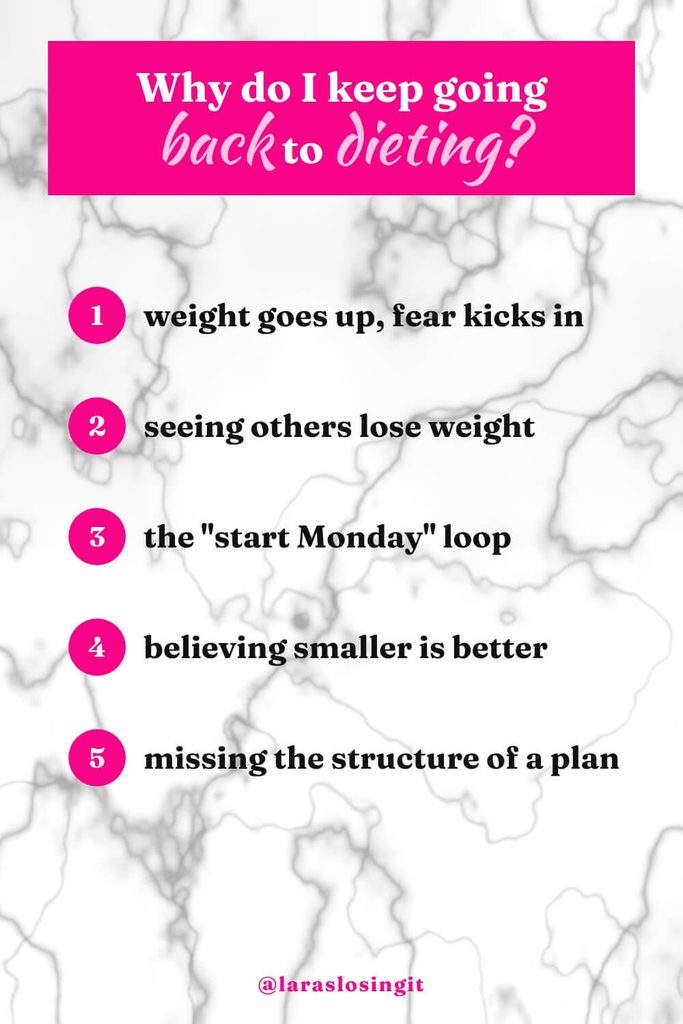
TL;DR: The most common triggers are weight going up, seeing someone else lose weight, the “start Monday” loop, believing life would be better in a smaller body, and missing the structure diets gave you. Naming yours is the first step.
1. Your Weight Goes Up and the Fear Kicks In
Weight creeping up can feel like an emergency. Some of the people I talk to are scared to buy the next size up in clothes, as if buying them makes it permanent.
That fear is what pushes people straight back to a diet. The panic feels urgent, and a plan feels like relief.
2. You See Someone Else Losing Weight
Social media, coworkers, and now GLP-1 before-and-after photos all say the same thing. Losing weight gets applause.
A follower told me she’s made peace with food and her body, but the world’s reaction to weight loss still bothers her. It’s hard to feel settled when everyone around you is being cheered for shrinking.
3. The “Start Monday” Loop
“I’ll start Monday” gives you a reason to eat everything today. Then Monday comes, you try to be perfect, and it falls apart by Wednesday.
Then the all-or-nothing thinking shows up. The whole week feels ruined, so you wait for the next Monday. I lived in this loop for years.
4. You Think Life Would Be Better in a Smaller Body
People have told me they’d have more energy, more confidence, even a better shot at a partner if they were slimmer. Those are real wants.
Weight loss isn’t a guaranteed route to any of them, though. Diets quietly attach a lot of hope to a number on the scale. If you want to dig into that, this post on what to ask yourself when you feel like you need to lose weight is a good place to start.
5. You Never Replaced What Dieting Gave You
This one gets missed. Dieting gives you a plan, rules, and a clear answer when you’re second-guessing yourself.
Without it, you’re left asking, “Is this the right food? Too much? Too little?” That kind of constant doubt is exhausting. Of course, a rulebook starts to look tempting again.
Why Does Quitting Dieting Feel Like Giving Up?
TL;DR: After years of diet culture, quitting a diet feels like quitting on yourself. But stopping a method that keeps failing isn’t giving up. It’s looking for something that works for you.
Another follower asked whether she should “go back to weighing everything and not ‘give up’ on dieting.” That phrase, give up, tells you a lot.
We’re taught that being on a diet means we’re trying and being off one means we’ve stopped caring. That’s diet culture talking.
If you’ve tried the same approach over and over and keep ending up in the same place, the issue isn’t that you quit. The method has a built-in revolving door.
What Actually Helps You Stop Going Back To Dieting?
TL;DR: Spot your trigger, ask what you actually want underneath the diet, keep gentle structure that isn’t a rulebook, stop mentally restricting, and wear clothes that fit now. Support makes it much easier.
1. Spot Your Trigger Before You Act
The next time you feel the pull, pause and ask what just happened. Did your jeans feel tight? Did you scroll past a transformation post? Was it Sunday night?
You don’t have to fix it right then. Noticing is the whole job for now.
2. Ask What You Actually Want Underneath the Diet
When I got pulled toward a GLP-1, I asked myself what I really wanted. It turned out I was stiff, tired, and uncomfortable in my clothes, and none of that needed weight loss to address.
Try it yourself. What do you believe losing weight would change for you? Is there a way to take care of that need directly? If you want the full story, it’s here.
3. Keep Gentle Structure That Isn’t a Diet
Some of us need structure, and that’s okay. The difference is between a boundary and a rule.
A boundary sounds like “I eat breakfast because I feel better when I do.” A rule sounds like “I can’t eat after 7pm.” Boundaries care for you. Rules punish you when you slip. If you’re not sure which is which, this checklist will help you spot a diet in disguise.
4. Stop Restricting in Your Head
Even if you’re not officially dieting, “I shouldn’t eat that” still counts as restriction. It also feeds the binge cycle that makes people run back to a diet. I explain how that works in How to Stop Binge Eating.
5. Buy Clothes That Fit Your Body Now
Waiting to shrink before buying clothes keeps you stuck in the “next size up” fear. Clothes that fit comfortably aren’t giving up. They’re basic care for the body you’re in today. I buy most of mine second hand, so it doesn’t have to be expensive.
6. Do It With Support
Most people who keep going back to dieting are trying to quit alone, with no plan for the hard moments. That’s like quitting something while everyone around you keeps offering it.
Support turns the next Monday from a crisis into something you can handle.
How Do I Stop Going Back To Dieting For Good?
TL;DR: You stop by learning to work with food noise, hunger, and your own cues instead of fighting them. That takes time and support. The Food Noise ResetTM is my 8-week program built for exactly that.
If the same triggers keep pulling you back, you don’t need another plan. You need a way to quiet the food noise, handle the hard moments, and make peace with your body without a rulebook.
That’s what The Food Noise ResetTM is for. It’s 8 weekly lessons, delivered by email, and each one takes about 30 to 45 minutes along with the exercises. There’s also a body acceptance module. Women who are on a GLP-1 are welcome too.
Join the Food Noise ResetTM waitlist here.
Not ready for that yet? Start with my free 5-Minute Emotional Eating Check-In Workbook. It helps you notice what’s really going on before you reach for a diet or for food. Download the free workbook here.
And if you’d rather work 1-on-1, here’s how coaching works.
FAQ: Why Do I Keep Going Back to Dieting?
Diets give quick results, certainty, and a sense of control, so they feel like the answer each time. Then the weight returns and the cycle restarts. It’s a habit with real triggers, not a flaw in you.
No. Plenty of people go back and forth while they unlearn diet culture. Each return is a chance to notice your trigger and respond differently.
Start by noticing that “Monday” is a rule you’re setting for later. Eat in a way that cares for you today, and drop the all-or-nothing idea that one off day ruins the week.
That fear is very common, and I won’t pretend your weight can’t change. What I can say is that fear-based restriction tends to lead to the binge cycle. Working on your food and body relationship gives you more steady footing than another diet does.
Yes. Being on a GLP-1 doesn’t mean you have to follow diet rules. If you’ve stopped one and eating feels intense, I wrote about binge eating after stopping a GLP-1 too. Questions about medication are for you and your prescriber.
Want more real talk on ditching diet culture for good? Come follow along on Instagram @laraslosingit!
Leave a Reply