
Quick answer: Binge eating after stopping a GLP-1 usually isn’t a willpower problem. As the medication clears over several weeks, your appetite signals and food noise return, often louder than you expected. If you’ve dieted for years, that can kick off the restrict-and-rebound cycle. Eating enough, skipping new food rules, and building one non-food way to cope helps most.
If you’re dealing with binge eating after stopping a GLP-1, I want you to hear this first: you’re not failing, and you didn’t break anything.
Let me be upfront about who’s writing this. I’m an intuitive eating coach, not a doctor, and I’ve never taken a GLP-1. I came close last year, and I wrote about that story here. So I can’t tell you what stopping feels like from the inside. What I do know is restriction, binge eating, and the restrict-rebound cycle, because I lived it, and now I help people out of it. That’s the lens for this post.
Anything medication-related, such as stopping, tapering, or restarting, is a conversation between you and your prescriber. This post is not meant to be a replacement for personal medical advice.
Why Does Hunger Come Back After Stopping a GLP-1?
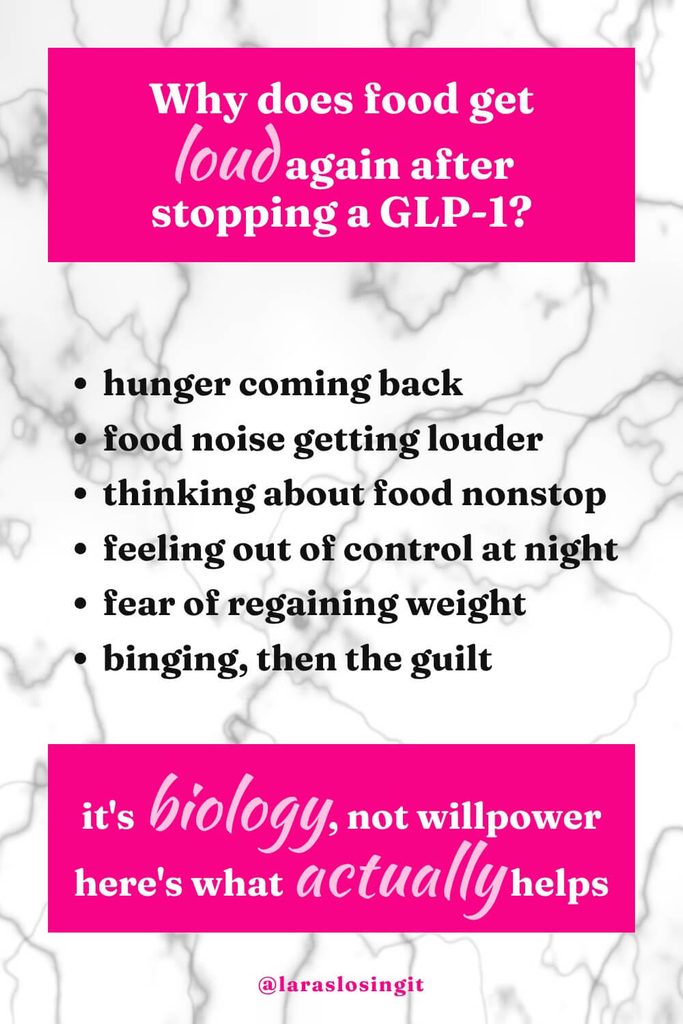
Quick answer: A GLP-1 turns down your appetite signals and food noise while it’s in your body. When it clears over several weeks, those signals go back to how they worked before. That’s biology, not a lack of willpower.
Here’s the thing: a GLP-1 doesn’t fix the reasons food felt loud in the first place. It turns the volume down while it’s in your system. Once it’s gone, the volume comes back up.
How fast depends on the medication and the dose. For a lot of people, it’s more of a gradual fade over the first month or two than a sudden switch. Your stomach also tends to return to emptying at its usual pace, so meals may feel less filling than they did while you were on the medication.
Now for the honest part. Studies show GLP-1s can reduce binge eating while people are taking them. Research on stopping has mostly focused on weight and metabolic rebound, so what happens to eating behaviour afterward remains poorly understood. So I won’t tell you that everyone who stops will binge. I will tell you that if it’s happening to you, it’s a pattern people report, and it has explanations that have nothing to do with you being weak.
Is It Hunger, Food Noise, or a Binge?
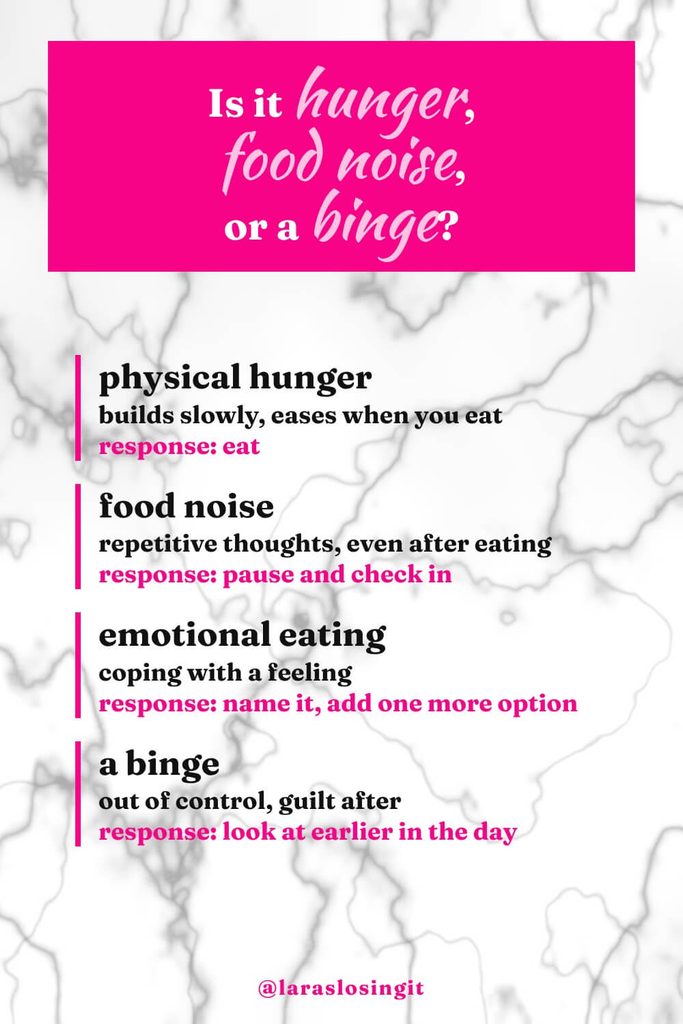
Quick answer: Hunger is a physical need that builds and eases when you eat. Food noise is repetitive, intrusive thinking about food. A binge feels out of control and goes past comfortable fullness. Each one needs a different response.
Not every food thought is a problem. Planning dinner, looking forward to a favourite meal, or thinking about what to pack for lunch is normal. That isn’t food noise, and it doesn’t need fixing.
Here’s how I tell them apart:
- Physical hunger builds gradually, shows up in your body, and eases once you eat.
- Food noise is repetitive, intrusive thinking about food, even when you aren’t hungry or have just eaten.
- Emotional eating is reaching for food to cope with a feeling. It’s normal, and I wrote a whole post on it.
- A binge feels out of control, goes past comfortable fullness, and usually comes with guilt afterward.
Why does this matter? Because each one needs a different response. More food helps with hunger. A pause and a check-in helps with food noise and emotional eating. A binge usually points back to something earlier in the day, like not eating enough.
Not sure which one you’re dealing with in the moment? My free 5-minute Emotional Eating Check-In Workbook walks you through it, no judgment attached. Download the free workbook here.
Why Binge Eating After Stopping a GLP-1 Feels So Intense
Quick answer: If you’ve dieted for years, the sudden return of hunger can feel like an emergency. Fear of regaining weight pushes people to restrict, and restriction is exactly what feeds the binge cycle.
Picture this. You’ve dieted on and off for years. Then you spend months with the quiet. And then the quiet ends.
Your body doesn’t know the difference between “the medication wore off” and “food might run out.” It just knows hunger is back, and it wants to be sure it gets fed.
Now add the fear. Fear of regaining weight, fear of being judged, fear of starting over. Most of us respond to fear the way we always have: by clamping down. Skipping breakfast, cutting out foods, being good all day.
Sound familiar?
That’s the restrict-and-rebound cycle, and it’s exactly what turns loud hunger into a binge by 9pm. Then the guilt shows up, and guilt makes the noise louder. If nights are your hardest time, I break down that pattern in “Why Do I Binge Eat at Night?“
What Actually Helps (Without Starting a Diet)
Quick answer: Eat enough on a steady rhythm. Resist adding new food rules. Check in before deciding it’s a binge. Plan one non-food way to decompress. And give your body weeks, not days, to settle.
1. Eat Enough, on a Rhythm
If your appetite was low for months, you may have gotten used to skipping meals or grazing. As hunger returns, aim for regular meals with real volume. That tells your body food keeps coming. Make them satisfying too, with protein, fibre, carbs, and fats you actually enjoy. Tiny portions or “saving up” for later tend to backfire. It’s the same fix I talk about in my nighttime binge post.
2. Skip the New Food Rules
Fear makes rules feel safe. No sugar, no carbs, nothing after 7pm. But rules are what keep the cycle spinning. Giving yourself full permission to eat, including the foods you’ve been avoiding, tends to quiet the food noise over time. A psychologist makes the same case in Psychology Today.
3. Check In Before You Decide It’s a Binge
Before you judge what’s happening, ask a few quick questions. When did I last eat? How was my day? What am I feeling right now? Often the honest answer is that you’re simply hungry. Sometimes it’s stress. Either way, you’re responding to something real instead of judging yourself for it. The check-in workbook gives you the exact prompts if you want them.
4. Build One Non-Food Way to Decompress
If food has been your main coping tool, losing the medication’s quiet can leave a gap. Fill it with one small non-food option. Five minutes in the car before you walk in the door. A text to a friend. A walk around the block. It doesn’t have to be fancy. The goal isn’t to never turn to food for comfort; it’s to have more than one option.
5. Give It Weeks, Not Days
You’re recalibrating, and that takes time. Expect a bumpy first month or two. A rough night doesn’t undo anything, and it doesn’t mean you’re back at square one. It’s uncomfy AF, but it’s information, not a verdict.

What About the Weight?
Quick answer: Weight regain is common after stopping, and I can’t promise what your body will do. What I can tell you is that a plan built on fear of regain tends to bring back the restrict-rebound cycle that makes everything louder.
Let’s be real. Trials show that many people regain a good portion of the weight they lost within a year of stopping. I’m not going to tell you that it won’t happen to you. I can’t promise what your body will do, and neither can anyone else.
Here’s what I’d gently ask instead: what does it cost you to try to prevent regain with restriction? For many people, the price is the binge cycle, the guilt, and a brain that’s busy with food all day.
If you want help with weight and health alongside your medical care, that’s a conversation to have with your doctor or a registered dietitian. My work helps you get steady with food so your choices come from care rather than panic.
When Should You Get More Support?
Quick answer: Talk to a doctor or an eating disorder specialist if eating feels truly out of control, if you’re restricting or purging, if food thoughts take up hours of your day, or if the distress is hard to carry.
Increased drinking since stopping is another one worth mentioning to your provider. You deserve real support, and asking for it isn’t overreacting. In the US, the National Alliance for Eating Disorders has a helpline, and in the UK, Beat offers support.
If you’re thinking about stopping, tapering, or restarting, loop in your prescriber first. Many clinicians recommend planning that change rather than stopping all at once.
This is the kind of work I do with coaching clients, untangling hunger, food noise, and old diet habits so you can eat without fear. And if food noise is what’s running your day, my program The Food Noise Reset™ was built for exactly that.
As the medication clears, your appetite signals and food noise return. If you also have a history of dieting or restricting, fear of regaining weight can push you to under-eat, which makes binges more likely. It’s biology and habit, not a lack of willpower.
There’s no single timeline. Many people notice their appetite changing over the first weeks as the medication clears, and it varies by drug, dose, and person. Your prescriber can tell you how long your specific medication stays in your system.
Trials show many people regain a significant portion of the weight within a year, though outcomes vary from person to person. Talk with your doctor about a plan that fits your health needs.
Yes. Your hunger and fullness cues may feel unfamiliar or loud at first, so start with regular meals, full permission with food, and a simple check-in before you decide anything. Give yourself patience while your body settles.
Not automatically. An occasional binge after an underfueled stretch is different from recurring episodes marked by a strong sense of losing control. If it’s frequent or distressing, or you’re also restricting or purging, please talk to a doctor or eating disorder specialist.
Want more real talk on ditching diet culture for good? Come follow along on Instagram @laraslosingit!