Category: Emotional Eating

  • Binge Eating After Stopping a GLP-1: Why It Happens and What Actually Helps

    Binge Eating After Stopping a GLP-1: Why It Happens and What Actually Helps

    Quick answer: Binge eating after stopping a GLP-1 usually isn’t a willpower problem. As the medication clears over several weeks, your appetite signals and food noise return, often louder than you expected. If you’ve dieted for years, that can kick off the restrict-and-rebound cycle. Eating enough, skipping new food rules, and building one non-food way to cope helps most.

    If you’re dealing with binge eating after stopping a GLP-1, I want you to hear this first: you’re not failing, and you didn’t break anything.

    Let me be upfront about who’s writing this. I’m an intuitive eating coach, not a doctor, and I’ve never taken a GLP-1. I came close last year, and I wrote about that story here. So I can’t tell you what stopping feels like from the inside. What I do know is restriction, binge eating, and the restrict-rebound cycle, because I lived it, and now I help people out of it. That’s the lens for this post.

    Anything medication-related, such as stopping, tapering, or restarting, is a conversation between you and your prescriber. This post is not meant to be a replacement for personal medical advice.

    Table of Contents

      Why Does Hunger Come Back After Stopping a GLP-1?

      Quick answer: A GLP-1 turns down your appetite signals and food noise while it’s in your body. When it clears over several weeks, those signals go back to how they worked before. That’s biology, not a lack of willpower.

      Here’s the thing: a GLP-1 doesn’t fix the reasons food felt loud in the first place. It turns the volume down while it’s in your system. Once it’s gone, the volume comes back up.

      How fast depends on the medication and the dose. For a lot of people, it’s more of a gradual fade over the first month or two than a sudden switch. Your stomach also tends to return to emptying at its usual pace, so meals may feel less filling than they did while you were on the medication.

      Now for the honest part. Studies show GLP-1s can reduce binge eating while people are taking them. Research on stopping has mostly focused on weight and metabolic rebound, so what happens to eating behaviour afterward remains poorly understood. So I won’t tell you that everyone who stops will binge. I will tell you that if it’s happening to you, it’s a pattern people report, and it has explanations that have nothing to do with you being weak.
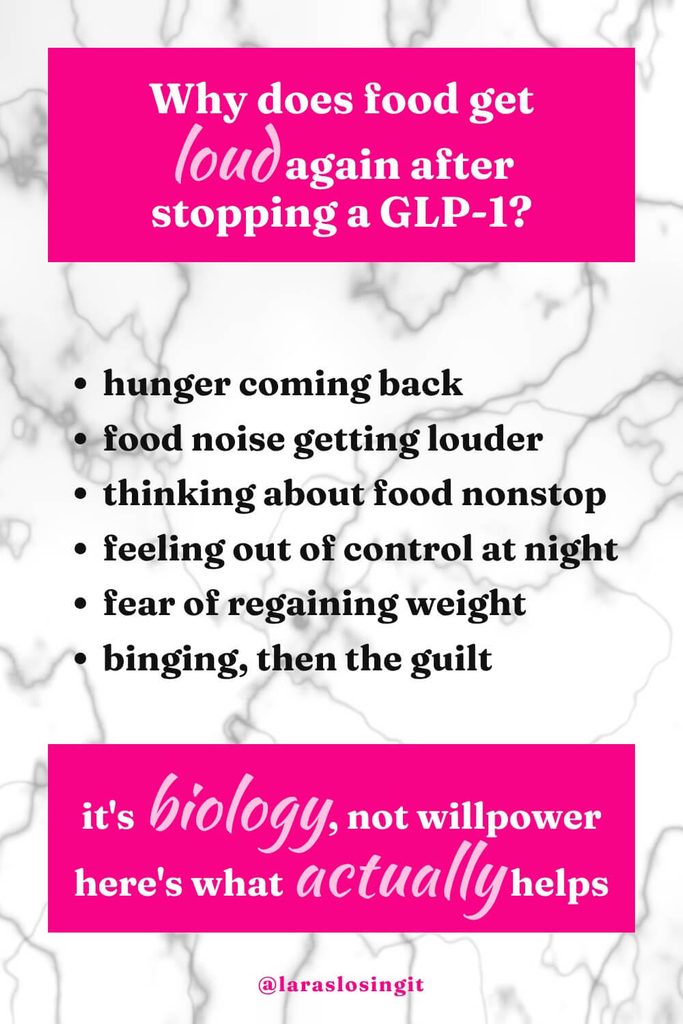
      Timeline showing why binge eating after stopping a GLP-1 can happen as appetite signals and food noise return

      Is It Hunger, Food Noise, or a Binge?

      Quick answer: Hunger is a physical need that builds and eases when you eat. Food noise is repetitive, intrusive thinking about food. A binge feels out of control and goes past comfortable fullness. Each one needs a different response.

      Not every food thought is a problem. Planning dinner, looking forward to a favourite meal, or thinking about what to pack for lunch is normal. That isn’t food noise, and it doesn’t need fixing.

      Here’s how I tell them apart:

      • Physical hunger builds gradually, shows up in your body, and eases once you eat.
      • Food noise is repetitive, intrusive thinking about food, even when you aren’t hungry or have just eaten.
      • Emotional eating is reaching for food to cope with a feeling. It’s normal, and I wrote a whole post on it.
      • A binge feels out of control, goes past comfortable fullness, and usually comes with guilt afterward.

      Why does this matter? Because each one needs a different response. More food helps with hunger. A pause and a check-in helps with food noise and emotional eating. A binge usually points back to something earlier in the day, like not eating enough.

      Not sure which one you’re dealing with in the moment? My free 5-minute Emotional Eating Check-In Workbook walks you through it, no judgment attached. Download the free workbook here.
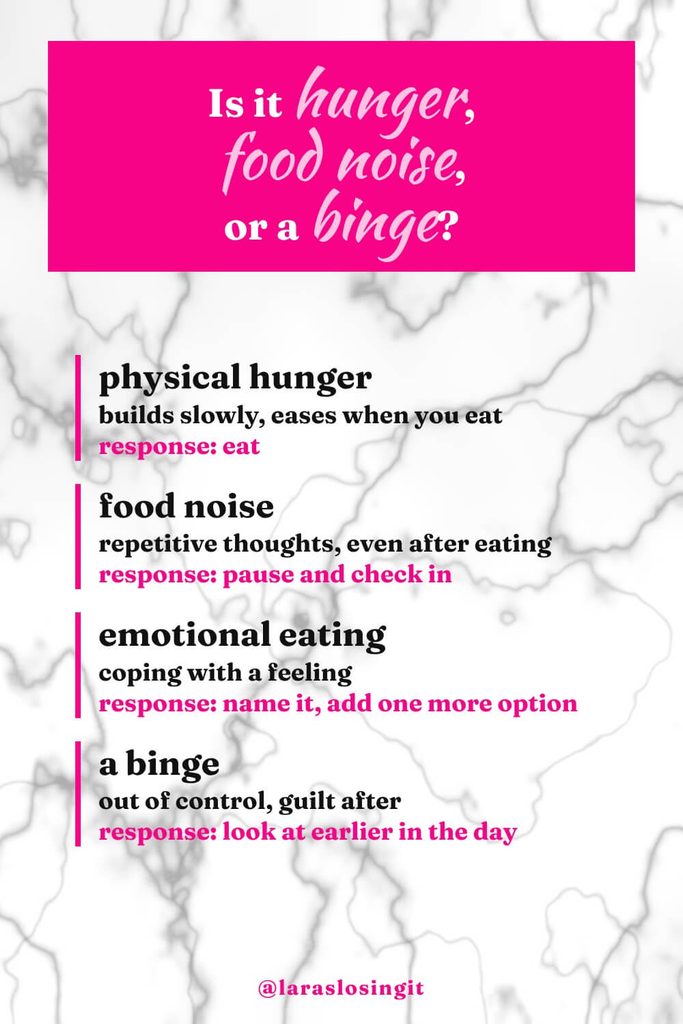
      Cheat sheet to tell hunger, food noise, emotional eating, and binge eating apart after stopping a GLP-1

      Why Binge Eating After Stopping a GLP-1 Feels So Intense

      Quick answer: If you’ve dieted for years, the sudden return of hunger can feel like an emergency. Fear of regaining weight pushes people to restrict, and restriction is exactly what feeds the binge cycle.

      Picture this. You’ve dieted on and off for years. Then you spend months with the quiet. And then the quiet ends.

      Your body doesn’t know the difference between “the medication wore off” and “food might run out.” It just knows hunger is back, and it wants to be sure it gets fed.

      Now add the fear. Fear of regaining weight, fear of being judged, fear of starting over. Most of us respond to fear the way we always have: by clamping down. Skipping breakfast, cutting out foods, being good all day.

      Sound familiar?

      That’s the restrict-and-rebound cycle, and it’s exactly what turns loud hunger into a binge by 9pm. Then the guilt shows up, and guilt makes the noise louder. If nights are your hardest time, I break down that pattern in “Why Do I Binge Eat at Night?“

      What Actually Helps (Without Starting a Diet)

      Quick answer: Eat enough on a steady rhythm. Resist adding new food rules. Check in before deciding it’s a binge. Plan one non-food way to decompress. And give your body weeks, not days, to settle.

      1. Eat Enough, on a Rhythm

      If your appetite was low for months, you may have gotten used to skipping meals or grazing. As hunger returns, aim for regular meals with real volume. That tells your body food keeps coming. Make them satisfying too, with protein, fibre, carbs, and fats you actually enjoy. Tiny portions or “saving up” for later tend to backfire. It’s the same fix I talk about in my nighttime binge post.

      2. Skip the New Food Rules

      Fear makes rules feel safe. No sugar, no carbs, nothing after 7pm. But rules are what keep the cycle spinning. Giving yourself full permission to eat, including the foods you’ve been avoiding, tends to quiet the food noise over time. A psychologist makes the same case in Psychology Today.

      3. Check In Before You Decide It’s a Binge

      Before you judge what’s happening, ask a few quick questions. When did I last eat? How was my day? What am I feeling right now? Often the honest answer is that you’re simply hungry. Sometimes it’s stress. Either way, you’re responding to something real instead of judging yourself for it. The check-in workbook gives you the exact prompts if you want them.

      4. Build One Non-Food Way to Decompress

      If food has been your main coping tool, losing the medication’s quiet can leave a gap. Fill it with one small non-food option. Five minutes in the car before you walk in the door. A text to a friend. A walk around the block. It doesn’t have to be fancy. The goal isn’t to never turn to food for comfort; it’s to have more than one option.

      5. Give It Weeks, Not Days

      You’re recalibrating, and that takes time. Expect a bumpy first month or two. A rough night doesn’t undo anything, and it doesn’t mean you’re back at square one. It’s uncomfy AF, but it’s information, not a verdict.
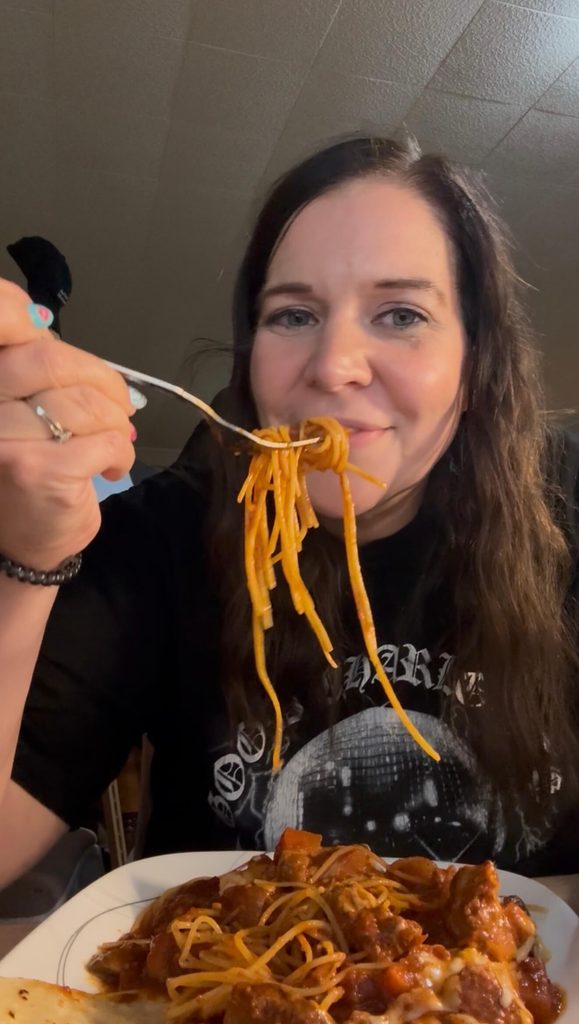
      Intuitive eating coach Lara enjoying a satisfying meal to help with binge eating after stopping a GLP-1

      What About the Weight?

      Quick answer: Weight regain is common after stopping, and I can’t promise what your body will do. What I can tell you is that a plan built on fear of regain tends to bring back the restrict-rebound cycle that makes everything louder.

      Let’s be real. Trials show that many people regain a good portion of the weight they lost within a year of stopping. I’m not going to tell you that it won’t happen to you. I can’t promise what your body will do, and neither can anyone else.

      Here’s what I’d gently ask instead: what does it cost you to try to prevent regain with restriction? For many people, the price is the binge cycle, the guilt, and a brain that’s busy with food all day.

      If you want help with weight and health alongside your medical care, that’s a conversation to have with your doctor or a registered dietitian. My work helps you get steady with food so your choices come from care rather than panic.

      When Should You Get More Support?

      Quick answer: Talk to a doctor or an eating disorder specialist if eating feels truly out of control, if you’re restricting or purging, if food thoughts take up hours of your day, or if the distress is hard to carry.

      Increased drinking since stopping is another one worth mentioning to your provider. You deserve real support, and asking for it isn’t overreacting. In the US, the National Alliance for Eating Disorders has a helpline, and in the UK, Beat offers support.

      If you’re thinking about stopping, tapering, or restarting, loop in your prescriber first. Many clinicians recommend planning that change rather than stopping all at once.

      This is the kind of work I do with coaching clients, untangling hunger, food noise, and old diet habits so you can eat without fear. And if food noise is what’s running your day, my program The Food Noise Reset™ was built for exactly that.

      Why am I binge eating after stopping Ozempic or another GLP-1?

      As the medication clears, your appetite signals and food noise return. If you also have a history of dieting or restricting, fear of regaining weight can push you to under-eat, which makes binges more likely. It’s biology and habit, not a lack of willpower.

      How long does food noise last after stopping a GLP-1?

      There’s no single timeline. Many people notice their appetite changing over the first weeks as the medication clears, and it varies by drug, dose, and person. Your prescriber can tell you how long your specific medication stays in your system.

      Will I regain weight after stopping a GLP-1?

      Trials show many people regain a significant portion of the weight within a year, though outcomes vary from person to person. Talk with your doctor about a plan that fits your health needs.

      Can I practice intuitive eating after stopping a GLP-1?

      Yes. Your hunger and fullness cues may feel unfamiliar or loud at first, so start with regular meals, full permission with food, and a simple check-in before you decide anything. Give yourself patience while your body settles.

      Is binge eating after stopping a GLP-1 an eating disorder?

      Not automatically. An occasional binge after an underfueled stretch is different from recurring episodes marked by a strong sense of losing control. If it’s frequent or distressing, or you’re also restricting or purging, please talk to a doctor or eating disorder specialist.


      Want more real talk on ditching diet culture for good? Come follow along on Instagram @laraslosingit!


    • How to Stop Binge Eating: What Actually Causes It (and What Helps)

      How to Stop Binge Eating: What Actually Causes It (and What Helps)

      Lara from Lara's Losing It Coaching, who struggled with binge eating for years

      If you’re here because you’re searching for how to stop binge eating, I want you to know something first: there is nothing wrong with you.

      If you’re familiar with my story, you know I struggled with binge eating for years. At the peak of my Binge Eating Disorder, I was bingeing every single day. It was one of the darkest times of my life, and I felt so helpless, out of control, and like there was something seriously wrong with me.

      There isn’t. And once I understood what was actually driving it, everything started to change.

      What Actually Causes Binge Eating?

      TL;DR: for most people, binge eating is driven by restriction (physical or mental), difficult emotions, or both… not a lack of willpower.

      There can be a lot of different things that contribute to binge eating, but for a lot of people (myself included), it ultimately comes back to restriction in some form.

      Maybe that’s an extreme diet. Maybe it’s just telling yourself to eat less sugar, stick to a slight calorie deficit, or lose some weight. If you aren’t fully allowing yourself to eat what you want, when you want it, that’s restriction, and your body reads that as a famine. So it puts your appetite into overdrive, just trying to keep you alive.

      Research backs this up too. A recent scoping review in Nutrition Reviews looked at 76 studies and found that most of them (about 70%) linked restrictive dieting to increased binge eating, especially when it’s combined with stress or difficult emotions. The evidence isn’t perfectly one-sided, but it lines up with what I see with clients (and lived myself) again and again: the more restricted you feel, the louder the urge to binge gets.

      Variety of foods representing food freedom instead of restriction, a key cause of binge eating

      Restriction Isn’t the Only Piece.. Emotional Eating Plays a Role Too

      Binge eating can also be spurred on by emotions, through emotional eating. When you’re dealing with something hard, and you turn to food for comfort, numbing, or a way to cope, that’s emotional eating.

      I want to be really clear here: there is nothing inherently wrong with emotional eating! Having a piece of cake at a birthday party is a great way to celebrate. A bowl of ice cream after a rough day, once in a while, is a great way to unwind.

      But if you’re regularly eating large quantities of food to the point of feeling sick, that’s bingeing, and it’s usually a sign that your self-care is lacking somewhere.

      Get Clear on What’s Actually Driving It

      Before you can stop binge eating, it helps to get honest about what’s fueling it for you. Is it restriction? A need for more self-care? Maybe a bit of both?

      Once you know that, here’s where I’d start.

      How to Stop Binge Eating: 4 Things That Actually Help

      1. Eat earlier in the day.

      Do you eat breakfast within an hour or two of waking? One of the most common patterns I see in people who struggle with binge eating is skipping breakfast entirely, maybe because they don’t feel hungry, or because a big coffee loaded with cream feels like enough. If you’re working on how to stop binge eating, this is the first place to look! Eat within an hour or two of waking, and include protein, fat, and carbohydrates so it doesn’t spike your blood sugar and actually sets you up for the day.

      Balanced breakfast with protein, fat, and carbs to help prevent binge eating.

      2. Eat every 2-5 hours, and make sure it’s enough.

      Keep including a mix of protein, fat, and carbohydrates at each meal and snack. Those macronutrients work together to help you absorb your micronutrients, keep your energy steady, and actually feel satisfied. Not eating enough throughout the day is one of the biggest drivers of binge eating, full stop.

      3. Avoid restriction, including mental restriction.

      Mental restriction is when you physically let yourself eat something, but you spend the whole time beating yourself up about it, or feeling guilty during or after. Satisfaction matters so much here. If you’re not fully letting yourself enjoy your food, it won’t feel as satisfying, and you’ll end up wanting more of it than if you’d just allowed yourself to enjoy it in the first place.

      4. Prioritize self-care.

      If you’re doing all of the above and still struggling, ask yourself: what do you actually do for self-care on a regular basis? This doesn’t need to be elaborate; a massage or a bubble bath isn’t required! Even just unwinding each night with a favourite show, a book, or some good music counts. Meditation, journaling, yoga, or light stretching all help too. When the urge to binge shows up, instead of heading to the pantry on autopilot, pause and ask yourself what you actually need in that moment. You might be surprised what comes up. Maybe it’s connection, and a call to a friend is what you really need. Maybe it’s just permission to rest. Don’t force yourself not to binge either; some nights that might genuinely be what you need. But when you build in daily self-care, you’ll notice that pull to binge starts to loosen on its own.

      Simple self-care routine that helps reduce the urge to binge eat

      Frequently Asked Questions

      Is emotional eating the same as binge eating?

      No. Emotional eating is sometimes turning to food for comfort, which is completely normal and not a problem on its own. It becomes binge eating when it happens regularly and involves eating past the point of comfort, to the point of feeling sick, and a feeling of loss of control over eating. While emotional eating and binge eating are not the same, emotional eating can lead to binge eating.

      Why do I binge eat even when I’m not physically hungry?

      This is usually a sign of restriction (your body compensating for not getting enough food or “allowed” foods earlier) or emotional eating (using food to cope with a hard feeling), rather than true physical hunger.

      Can you stop binge eating without dieting?

      Yes, and for most people, this is actually the more effective path. Since restriction is one of the biggest drivers of binge eating, adding another diet on top of it usually makes bingeing worse, not better.

      How long does it take to stop binge eating?

      It’s different for everyone. The habits in this post (eating enough and often, dropping mental restriction, building in daily self-care) are the foundation, but for many people it also takes time and, ideally, support from a coach or therapist who specializes in this.

      There is nothing wrong with you — quote from Lara's Losing It Coaching on binge eating recovery.

      About Lara: Lara is a Certified Intuitive Eating Pro Lay Facilitator and Certified Transformational Nutrition Coach who helps women break free from the cycle of dieting, bingeing, guilt, and starting over, drawing on her lived experience with Binge Eating Disorder and years of coaching clients through the same struggle.


      Sources Cited

      Scoping review on restrictive diets and binge eating disorder, Nutrition Reviews (Oxford Academic): https://academic.oup.com/nutritionreviews/article-abstract/84/1/189/8240324

    • Why Do I Binge Eat at Night? It’s Not Willpower… It’s Supply and Demand

      Why Do I Binge Eat at Night? It’s Not Willpower… It’s Supply and Demand

      Quick answer: Why do I binge eat at night? If you eat “perfectly” all day and then find yourself in the pantry at 9pm eating straight out of the bag, you’re not broken. And you’re not lacking willpower. Nighttime bingeing usually comes down to one of three things: under-eating during the day, stress, or a body still guarded from years of restriction. The fix isn’t more willpower at night. It’s addressing what happened earlier in the day.

      Table of Contents

        Why do I binge eat at night – It’s not a willpower problem

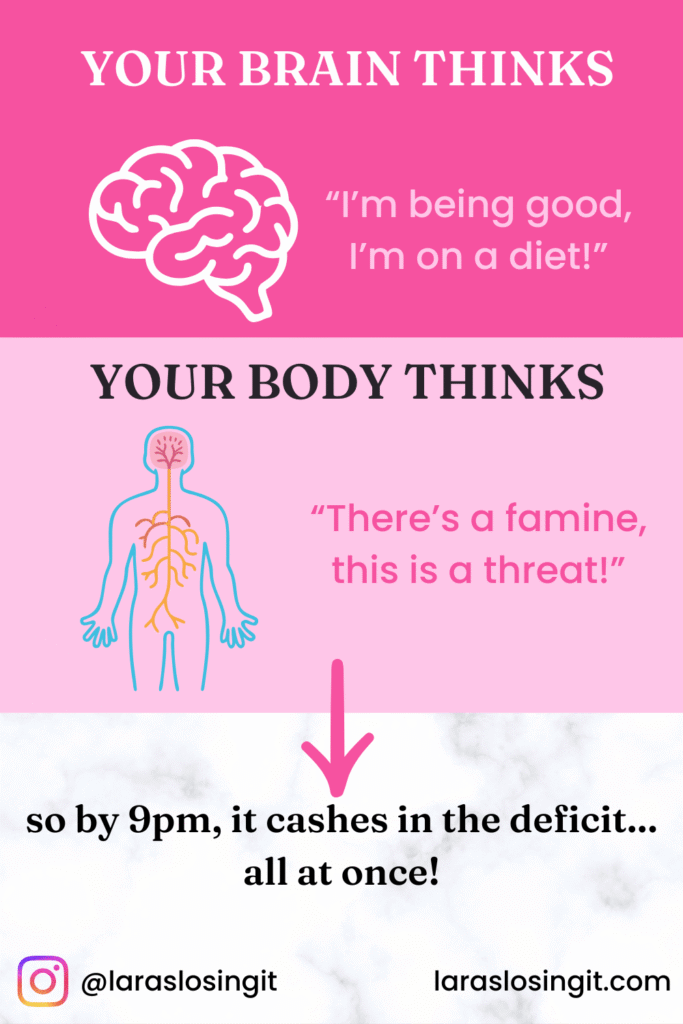
        Quick answer: It’s not a willpower problem; it’s a supply and demand problem. Your body spends the day building up a deficit. By evening, when you’re naturally more exhausted and willpower (a finite resource, not a personality trait) has run out, your body cashes in that deficit all at once.

        Here’s the thing that nobody tells you when you’re deep in diet culture: your body doesn’t know the difference between “I’m on a diet” and “there’s a famine.” It just knows it didn’t get enough, and it’s going to make sure it gets enough eventually… usually around 9 pm, standing in front of the open pantry.

        Your Body Doesn’t Know “Diet” From “Famine”

        If you under-eat during the day, skip meals, or white-knuckle your way through “being good,” your body spends all day building up a deficit. It doesn’t care about your calorie math or your intentions; it just registers that not enough came in. By the time evening rolls around and willpower has run out, that deficit gets cashed in all at once.

        Why do I binge eat at night? brain vs. body diet and famine graphic

        The 3 Most Common Causes of Nighttime Binge Eating

        Quick answer: The three most common drivers are under-eating during the day, using food to process stress or emotions, and a body that’s learned, from years of restriction, to hold onto and grab food whenever it’s available.

        1. You’re Under-Eating During the Day

        If breakfast is coffee, lunch is “whatever’s fastest,” and you’re telling yourself you’re “saving calories” for later, you’re setting up a night of bingeing. Your body isn’t interested in your calorie math… it just knows it’s hungry.

        2. You’re Using Food to Process the Day

        Work stress, a hard conversation, the mental load of running a household… food can genuinely soothe in the moment. That’s not a character flaw; it’s one of the only tools a lot of us were ever given for emotional regulation. The problem isn’t that food comforts you. The problem is when it’s the only tool in the toolbox.

        3. Years of Restriction Have Taught Your Body Not to Trust You

        If you’ve dieted on and off for a long time, your body has learned that food isn’t always reliably available. That makes it hold on tighter and grab more when it is available, even if you’re not currently restricting. This isn’t something you can think your way out of overnight… it takes consistent, adequate eating over time to teach your body it can trust you again.

        What Actually Helps

        Quick answer: Eat enough, earlier in the day. Build in a check-in before you judge what’s happening at night. And find at least one non-food way to come down from the day, so food isn’t the only tool available.

        Eat enough, earlier. This sounds almost too simple, but it’s the single highest-leverage change most people can make. That means real meals with actual volume, not just snacks stacked on top of each other. If dinner is a salad and a granola bar, your 9 pm self won’t be satisfied with “just a little something.”

        Build in a check-in before you decide anything about the binge. Before you judge what’s happening at night, ask: did I eat enough today? Often the honest answer is no, and that reframes the whole moment from “I have no control” to “my body is asking for what I didn’t give it earlier.”

        If this pattern feels familiar, I built a free 5-minute Emotional Eating Check-In Guide to help you start noticing what’s actually driving it. Before you’re on autopilot reaching for food. Grab it here.

        Find one non-food way to come down from the day, even a small one. This isn’t about replacing food with some elaborate self-care routine. It can be as small as five minutes in the car before you walk in the door, or as simple as texting a friend instead of going straight to the kitchen. The goal isn’t to never turn to food for comfort again… it’s to have more than one option.

        A full dinner plate... eating enough during the day helps stop binge eating at night

        This Isn’t Something You Fix in One Night

        If you’re in this pattern right now, please know: one binge, or even a stretch of them, doesn’t undo progress or mean you’re back at square one. It means your body is telling you something… usually that it didn’t get enough earlier, or that today was a lot to carry. The goal isn’t perfect eating. It’s building enough trust with your body over time that food stops feeling like something you have to control or escape from.

        This is exactly the work I do with coaching clients – untangling the difference between a body that’s genuinely hungry and a nervous system that’s overwhelmed, and building a relationship with food that doesn’t depend on willpower at all.

        Not sure which pattern is driving your eating? Take my free 2-minute quiz – What’s REALLY Keeping You From Food Freedom? to find your starting point.

        FAQ: Why Do I Binge Eat at Night?

        Why do I binge eat at night even when I eat healthy all day?

        “Healthy” and “enough” aren’t the same thing. If your meals are light on volume or you’re skipping/delaying eating to “save room,” your body can build a deficit all day even while eating foods you’d consider healthy… and it cashes that deficit in at night.

        Is nighttime bingeing a sign of a bigger problem?

        Occasional nighttime bingeing after an under-fueled day is common and usually resolves by eating enough, earlier. If it’s happening frequently, involves a strong sense of losing control, or is affecting your physical or mental health, it’s worth talking to a doctor or therapist… this post covers the common, restriction-driven pattern, not clinical binge eating disorder.

        How do I stop stress eating at night?

        Start by naming it – noticing when you’re reaching for food to soothe stress rather than out of hunger. From there, build in one non-food way to decompress (even five minutes), so food isn’t the only option available when stress hits.

        Can restricting during the day cause bingeing at night even if I’m not “on a diet”?

        Yes. Any pattern of under-eating – skipping meals, delaying food, “saving calories” – sends the same signal to your body regardless of whether you’d call it a diet. Years of that pattern can also condition your body to hold on tighter to food long after the restriction itself has stopped.


        If this pattern feels familiar, come follow along on Instagram @laraslosingit for more real talk on ditching diet culture for good.

      • Emotional Eating as a Non-Dieter: Why It’s Normal (and What Actually Helps)

        Emotional Eating as a Non-Dieter: Why It’s Normal (and What Actually Helps)

        Quick answer: Emotional eating without dieting doesn’t mean eliminating it, it means understanding it. Emotional eating is a completely normal way to cope, and everyone does it sometimes! It’s only worth a closer look if it’s become your main way of dealing with hard emotions, or if it’s tipping into a binge (which is usually a sign of restriction, not a lack of willpower). The first step isn’t quitting.. it’s noticing your patterns.

        Table of Contents

          Is Emotional Eating Actually Bad?

          Quick answer: No! Emotional eating is completely normal, and diet culture has demonized something that’s actually a natural part of being human.

          I talk with people about emotional eating and emotional binge eating all the time. What they describe is exactly what I’ve experienced myself, turning to food to deal with a certain emotion or situation, and then feeling totally out of control with that food in the moment.

          I used to get so focused on trying to completely quit eating emotionally, or quit bingeing altogether. Guess what? It never worked!

          Here’s the thing: eating emotionally is completely normal. Everyone does it every now and then. Diet culture has demonized the act of eating to comfort ourselves, but it’s actually pretty natural. Food is meant to bring us satisfaction, and satisfaction and comfort go hand in hand! So don’t beat yourself up for emotional eating.

          (Side note: if emotional eating often turns into a full binge for you, you’re very likely restricting that food somewhere else.. which changes the picture a bit. I go deep on that connection in Why Do I Binge Eat at Night? if that sounds familiar.)

          When Emotional Eating Is Worth a Closer Look

          Quick answer: If emotional eating has become your main way of dealing with uncomfortable emotions, and it’s having a real negative impact on your life, it’s worth exploring other ways to cope. Not because emotional eating is “bad,” but because you deserve more than one tool.

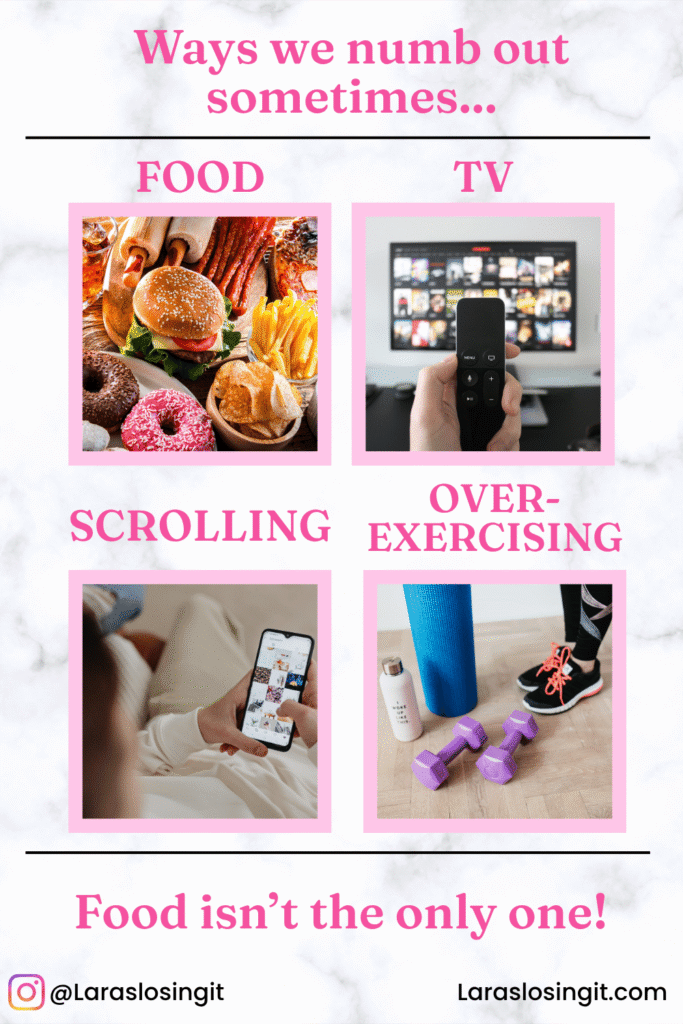
          It’s also important to actually feel some of these emotions and process them, that’s part of the human experience!! If you’re mainly numbing feelings out, whether with food or with other things like TV, mindless scrolling, or even exercise, that’s not going to help you long term either. Food isn’t the only numbing tool out there, and it’s not uniquely villain-coded compared to the rest of them.

          Emotional eating without dieting: food, TV, scrolling, and over-exercising are all ways we numb out

          Emotional Eating vs. Emotional Binge Eating

          Emotional eating and emotional binge eating aren’t the same thing, and it’s worth knowing the difference.

          Emotional eating is reaching for food to cope with a feeling, stress, sadness, boredom, loneliness. It’s normal, and on its own it isn’t a problem to fix.

          Emotional binge eating is when that turns into feeling completely out of control with food in the moment, like you couldn’t stop even if you wanted to. That loss-of-control feeling is usually less about the emotion itself and more about restriction happening somewhere else in your eating. If that’s the pattern you’re in, Why Do I Binge Eat at Night breaks down exactly why that happens and what helps.

          How to Actually Notice Your Patterns

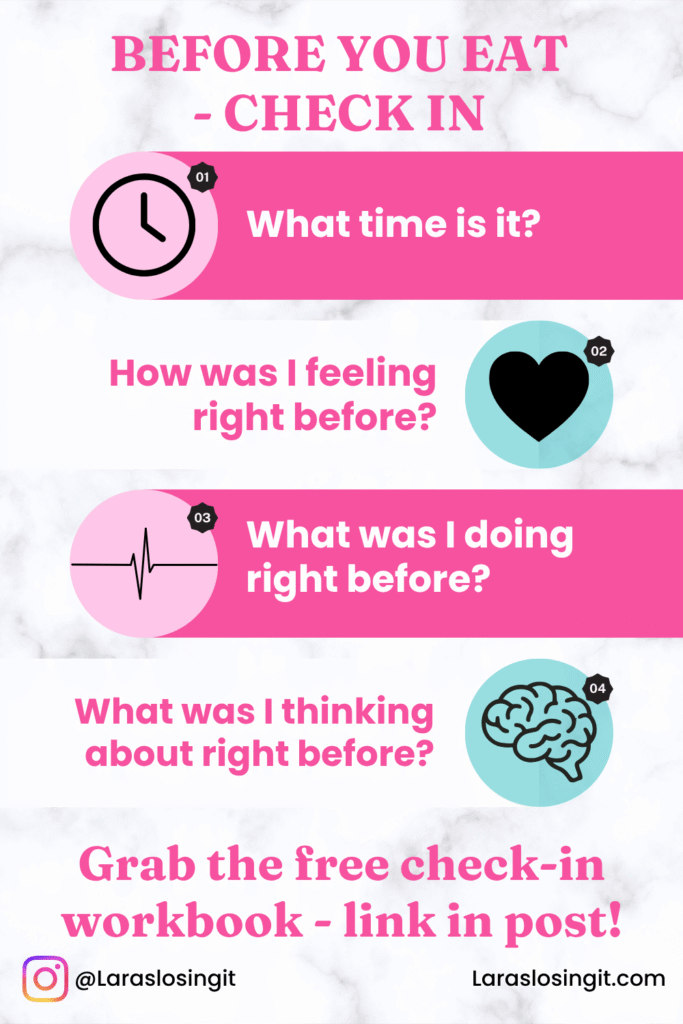
          Quick answer: Start by journaling the moments you turn to food for reasons other than hunger, the time, how you were feeling, what you were doing, and what you were thinking about right before.

          The first step is to begin recognizing the common times you turn to food for reasons other than hunger. This might not even always be tied to a specific emotion, it can be pretty habitual too. Either way, the best way to catch it is to journal.

          Note things like:

          • What time it is
          • How you were feeling right before
          • What you were doing right before
          • What you were thinking about right before

          When I first did this myself, I found I was eating as a form of procrastination a lot more than I expected!

          Emotional eating without dieting journal prompts: what time is it, how were you feeling, what were you doing, what were you thinking before you ate

          What to Do Once You See the Pattern

          Quick answer: Once you can see your patterns clearly, you can start facing what’s underneath them directly, whether that’s stress, grief, or something else, instead of reaching for food or a distraction every time it comes up.

          Once you’re able to see the patterns, you can start to tackle them. If there’s a big stress in your life that you notice you turn to food around every time you start thinking about it, maybe it’s time to actually face that thing head on.

          If you’ve recently gone through a loss and you’re just feeling sad from that, allow yourself to sit in that feeling without turning on the TV or grabbing food. Meditate, journal, allow yourself to actually feel the emotions and process them. It’s uncomfy AF, but if you don’t deal with them, they will keep coming back up.. Ruthlessly!

          This is exactly the kind of pattern work I do with coaching clients, helping you tell the difference between genuine hunger, a nervous system that’s overwhelmed, and everything in between.

          I also have a free Emotional Eating Check-In Workbook to help walk you through this exact process, a simple, judgment-free way to start noticing what’s actually driving it, before you’re on autopilot reaching for food. Download the free guide here and let me know how it goes!

          Not sure which pattern is even driving your eating in the first place? My free 2-minute quiz, What’s REALLY Keeping You From Food Freedom?, can help you find your starting point.

          FAQ: Emotional Eating Without Dieting

          Is emotional eating a form of disordered eating?

          Not on its own. Emotional eating is a normal coping behavior most people use sometimes. It becomes worth closer attention if it’s your main or only coping tool, if it’s happening very frequently, or if it’s tipping into a loss-of-control binge, which is often a sign of restriction elsewhere, not a character flaw.

          How do I stop emotional eating without dieting?

          You don’t have to stop it entirely, the goal is to understand it, not eliminate it. Start by journaling the moments you reach for food outside of hunger, look for patterns, and build in other ways (rest, processing the emotion directly, talking it through) so food isn’t the only tool available.

          Is it normal to emotionally eat even as an intuitive eater?

          Yes! Even people fully practicing intuitive eating still emotionally eat sometimes, it’s a normal, human way to cope, not a sign you’re doing intuitive eating “wrong.”

          What’s the difference between emotional eating and binge eating?

          Emotional eating is reaching for food to cope with a feeling. Binge eating adds a loss-of-control element, feeling like you can’t stop. That loss-of-control feeling is usually driven by restriction happening somewhere else, not by the emotion itself.


          Want more real talk on ditching diet culture for good? Come follow along on Instagram @laraslosingit!