Category: Intuitive Eating

  • Why Do I Keep Going Back to Dieting? 5 Real Reasons (and What Helps)

    Why Do I Keep Going Back to Dieting? 5 Real Reasons (and What Helps)

    TL;DR: You keep going back to dieting because a diet offers a plan, certainty, and hope at the exact moment weight fear, social pressure, or a rough week hits. It’s not weak willpower. It’s a learned habit with real triggers. You stop by spotting your trigger, asking what you actually want underneath the diet, and replacing the structure diets gave you with gentle boundaries that aren’t rules.

    Why do I keep going back to dieting? If you’ve asked yourself that, you’re in good company.

    A follower told me, “I’ve tried quitting dieting several times in the last few years, but I keep going back to it.” Another said, “Every week I think I’ll start Monday.” Sound familiar?

    Here’s where I’m coming from. I started dieting at 19 and kept at it for about 15 years. Calorie counting hooked me the most, and at one point I became a Beachbody coach, which was basically a weight-loss coach lol. So I know the pull. I felt it again last year, and I wrote about that whole story here.

    This post is about why the pull keeps happening and what actually helps you stop. It’s not about you being weak or doing it wrong.

    Is Going Back To Dieting a Willpower Problem?

    TL;DR: No. Going back to dieting is a habit built on years of hearing that your body is a problem to fix. Diets also work for a while, which keeps you coming back. Willpower isn’t the missing piece.

    Let’s be real. Diets often do something in the short term. The scale moves, you get compliments, and you feel in control.

    Then the weight comes back, because it usually does. Research on long-term weight loss shows most people regain it, and I break that down in another post. So the diet “failed,” and somehow we blame ourselves instead of the diet.

    That’s the loop. A short win, a regain, a bit of shame, and then the next plan looks like the answer. Of course, you keep going back.

    Why Do I Keep Going Back To Dieting? 5 Real Reasons.

    TL;DR: The most common triggers are weight going up, seeing someone else lose weight, the “start Monday” loop, believing life would be better in a smaller body, and missing the structure diets gave you. Naming yours is the first step.

    1. Your Weight Goes Up and the Fear Kicks In

    Weight creeping up can feel like an emergency. Some of the people I talk to are scared to buy the next size up in clothes, as if buying them makes it permanent.

    That fear is what pushes people straight back to a diet. The panic feels urgent, and a plan feels like relief.

    2. You See Someone Else Losing Weight

    Social media, coworkers, and now GLP-1 before-and-after photos all say the same thing. Losing weight gets applause.

    A follower told me she’s made peace with food and her body, but the world’s reaction to weight loss still bothers her. It’s hard to feel settled when everyone around you is being cheered for shrinking.

    3. The “Start Monday” Loop

    “I’ll start Monday” gives you a reason to eat everything today. Then Monday comes, you try to be perfect, and it falls apart by Wednesday.

    Then the all-or-nothing thinking shows up. The whole week feels ruined, so you wait for the next Monday. I lived in this loop for years.

    4. You Think Life Would Be Better in a Smaller Body

    People have told me they’d have more energy, more confidence, even a better shot at a partner if they were slimmer. Those are real wants.

    Weight loss isn’t a guaranteed route to any of them, though. Diets quietly attach a lot of hope to a number on the scale. If you want to dig into that, this post on what to ask yourself when you feel like you need to lose weight is a good place to start.

    5. You Never Replaced What Dieting Gave You

    This one gets missed. Dieting gives you a plan, rules, and a clear answer when you’re second-guessing yourself.

    Without it, you’re left asking, “Is this the right food? Too much? Too little?” That kind of constant doubt is exhausting. Of course, a rulebook starts to look tempting again.
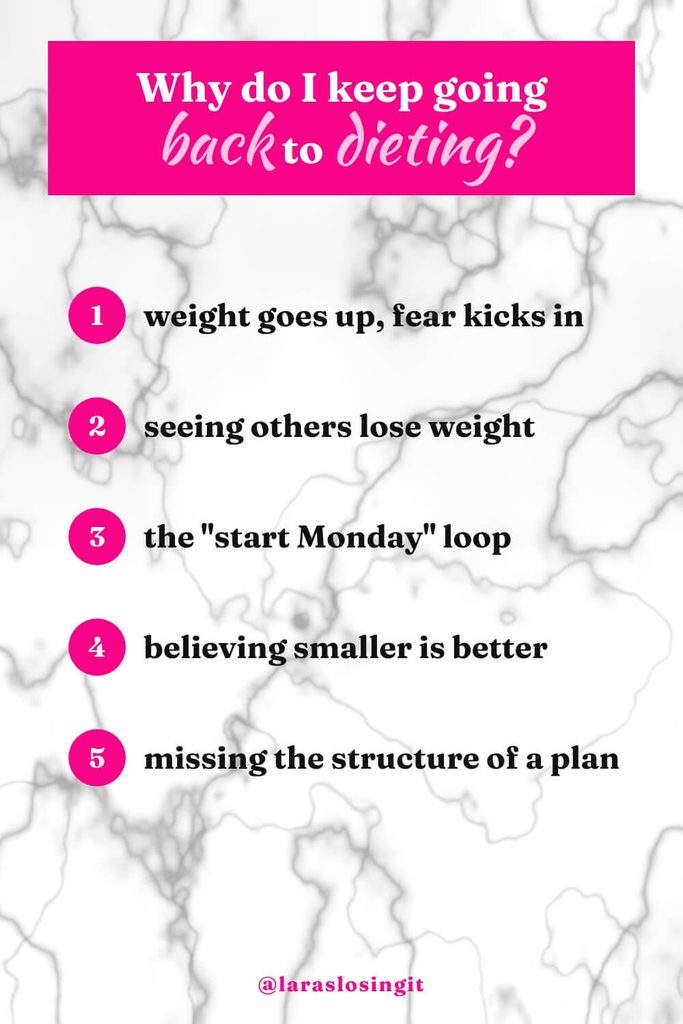
    Graphic listing 5 reasons why do I keep going back to dieting: weight fear, seeing others lose weight, the start Monday loop, believing smaller is better, and missing structure

    Why Does Quitting Dieting Feel Like Giving Up?

    TL;DR: After years of diet culture, quitting a diet feels like quitting on yourself. But stopping a method that keeps failing isn’t giving up. It’s looking for something that works for you.

    Another follower asked whether she should “go back to weighing everything and not ‘give up’ on dieting.” That phrase, give up, tells you a lot.

    We’re taught that being on a diet means we’re trying and being off one means we’ve stopped caring. That’s diet culture talking.

    If you’ve tried the same approach over and over and keep ending up in the same place, the issue isn’t that you quit. The method has a built-in revolving door.

    What Actually Helps You Stop Going Back To Dieting?

    TL;DR: Spot your trigger, ask what you actually want underneath the diet, keep gentle structure that isn’t a rulebook, stop mentally restricting, and wear clothes that fit now. Support makes it much easier.

    1. Spot Your Trigger Before You Act

    The next time you feel the pull, pause and ask what just happened. Did your jeans feel tight? Did you scroll past a transformation post? Was it Sunday night?

    You don’t have to fix it right then. Noticing is the whole job for now.

    2. Ask What You Actually Want Underneath the Diet

    When I got pulled toward a GLP-1, I asked myself what I really wanted. It turned out I was stiff, tired, and uncomfortable in my clothes, and none of that needed weight loss to address.

    Try it yourself. What do you believe losing weight would change for you? Is there a way to take care of that need directly? If you want the full story, it’s here.

    3. Keep Gentle Structure That Isn’t a Diet

    Some of us need structure, and that’s okay. The difference is between a boundary and a rule.

    A boundary sounds like “I eat breakfast because I feel better when I do.” A rule sounds like “I can’t eat after 7pm.” Boundaries care for you. Rules punish you when you slip. If you’re not sure which is which, this checklist will help you spot a diet in disguise.

    4. Stop Restricting in Your Head

    Even if you’re not officially dieting, “I shouldn’t eat that” still counts as restriction. It also feeds the binge cycle that makes people run back to a diet. I explain how that works in How to Stop Binge Eating.

    5. Buy Clothes That Fit Your Body Now

    Waiting to shrink before buying clothes keeps you stuck in the “next size up” fear. Clothes that fit comfortably aren’t giving up. They’re basic care for the body you’re in today. I buy most of mine second hand, so it doesn’t have to be expensive.

    6. Do It With Support

    Most people who keep going back to dieting are trying to quit alone, with no plan for the hard moments. That’s like quitting something while everyone around you keeps offering it.

    Support turns the next Monday from a crisis into something you can handle.

    How Do I Stop Going Back To Dieting For Good?

    TL;DR: You stop by learning to work with food noise, hunger, and your own cues instead of fighting them. That takes time and support. The Food Noise ResetTM is my 8-week program built for exactly that.

    If the same triggers keep pulling you back, you don’t need another plan. You need a way to quiet the food noise, handle the hard moments, and make peace with your body without a rulebook.

    That’s what The Food Noise ResetTM is for. It’s 8 weekly lessons, delivered by email, and each one takes about 30 to 45 minutes along with the exercises. There’s also a body acceptance module. Women who are on a GLP-1 are welcome too.

    Join the Food Noise ResetTM waitlist here.

    Not ready for that yet? Start with my free 5-Minute Emotional Eating Check-In Workbook. It helps you notice what’s really going on before you reach for a diet or for food. Download the free workbook here.

    And if you’d rather work 1-on-1, here’s how coaching works.

    FAQ: Why Do I Keep Going Back to Dieting?

    Why do I keep going back to dieting even though it never works long term?

    Diets give quick results, certainty, and a sense of control, so they feel like the answer each time. Then the weight returns and the cycle restarts. It’s a habit with real triggers, not a flaw in you.

    Is going back to dieting a sign I can’t do intuitive eating?

    No. Plenty of people go back and forth while they unlearn diet culture. Each return is a chance to notice your trigger and respond differently.

    How do I stop the “I’ll start Monday” cycle?

    Start by noticing that “Monday” is a rule you’re setting for later. Eat in a way that cares for you today, and drop the all-or-nothing idea that one off day ruins the week.

    What if I’m scared of gaining weight if I stop dieting?

    That fear is very common, and I won’t pretend your weight can’t change. What I can say is that fear-based restriction tends to lead to the binge cycle. Working on your food and body relationship gives you more steady footing than another diet does.

    Can I stop dieting if I’m on a GLP-1?

    Yes. Being on a GLP-1 doesn’t mean you have to follow diet rules. If you’ve stopped one and eating feels intense, I wrote about binge eating after stopping a GLP-1 too. Questions about medication are for you and your prescriber.

    Want more real talk on ditching diet culture for good? Come follow along on Instagram @laraslosingit!
  • How I Quiet Food Noise Without a GLP-1 (My Honest Story)

    How I Quiet Food Noise Without a GLP-1 (My Honest Story)

    TL;DR: I’m a food freedom & intuitive eating coach, and last year I still almost signed up for a GLP-1 medication. What stopped me wasn’t willpower; it was getting curious about why I actually wanted to lose weight in the first place. Underneath “I need to lose weight” was a real, specific discomfort (stiffness, low energy, clothes that didn’t fit right), and none of that actually required weight loss to fix. Reconnecting with gentle movement and gentle nutrition quieted my food noise without a prescription. This is my story, not an argument against GLP-1s for anyone else.

    Table of Contents

      The Night I Almost Signed Up for a GLP-1

      I want to talk about something that might surprise people coming from an intuitive eating and food freedom coach.. last year, I strongly considered going on a GLP-1 medication.

      I had already healed my relationship with food and my body years earlier. I’d been an intuitive eater for years. I knew how to recognize diet culture; I understood restriction and the restrict-rebound cycle, and I genuinely felt confident around food. And still, I got pulled into the GLP-1 conversation.

      Here’s the honest part: at that point, my food noise was loud. I felt like I was back to being “addicted” to certain foods, my appetite felt huge, and I was struggling not to overeat every single night. So when I started seeing GLP-1s described as something that could quiet all of that, quiet my mind around food entirely, it was genuinely appealing. Who wouldn’t want the noise to just.. stop?

      One night, I found myself up late researching them. Googling. On TikTok, listening to people’s experiences. Trying to figure out whether this was something I should do. I got far enough that I actually signed up for a consultation through an online service that prescribed GLP-1 medications. I ultimately didn’t go through with it, but I came very close.

      Why I Hesitated (Even With the Loud Food Noise)

      TL;DR: I wasn’t approaching the question neutrally; I was trying to convince myself to say yes. But listening to various people’s personal accounts of “food noise” returning with a vengeance after stopping GLP-1s made me pause and ask what I was actually looking for.

      I think it’s important to be honest about the headspace I was in while doing all that research: I wasn’t approaching the question neutrally. At that point, I was trying to convince myself to take the medication. That matters, because confirmation bias is real. When we’re searching online, especially on social media, it’s incredibly easy to find the information that supports the answer we already want.

      But while I was looking for reasons to say yes, I kept coming across something that made me hesitate. I saw accounts from people who’d taken GLP-1 medications, stopped, and described their hunger and food noise returning intensely. Some described feeling like their appetite was even harder to manage after stopping.

      Those personal accounts made me ask myself a bigger question: what was I actually looking for here?

      For me, the idea of needing an intervention indefinitely just to maintain its effects felt uncomfortably familiar. It brought me right back to the dynamic I’d spent years getting away from.. doing something primarily to make my body smaller, knowing that if I stopped, I might end up right back where I started, food noise and all.

      The Question Underneath “Should I Take a GLP-1?”

      TL;DR: Instead of asking “should I take a GLP-1,” I got curious about the question underneath it: why do I want to lose weight right now? The surface answer was “I gained weight.” That wasn’t the whole answer.

      So instead of continuing to ask “should I take a GLP-1,” I got curious about the question underneath it: “why do I want to lose weight right now?“

      The surface-level answer was obvious. I had gained weight. But that wasn’t really the whole answer.

      The previous couple of years had been difficult and stressful. A lot of the practices that normally helped me feel good had fallen to the wayside. Somewhere in there, I stopped paying much attention to one important part of being an intuitive eater: gentle nutrition.

      I was eating a lot of foods I genuinely enjoy- chips, pizza, cookies, other fun foods- but I wasn’t paying much attention to how my overall eating patterns were making me feel. I wasn’t exercising consistently either. Over time, I gained some weight, and my food noise crept back up right along with it.

      What I Found When I Got Curious

      So I kept digging. What was actually bothering me?

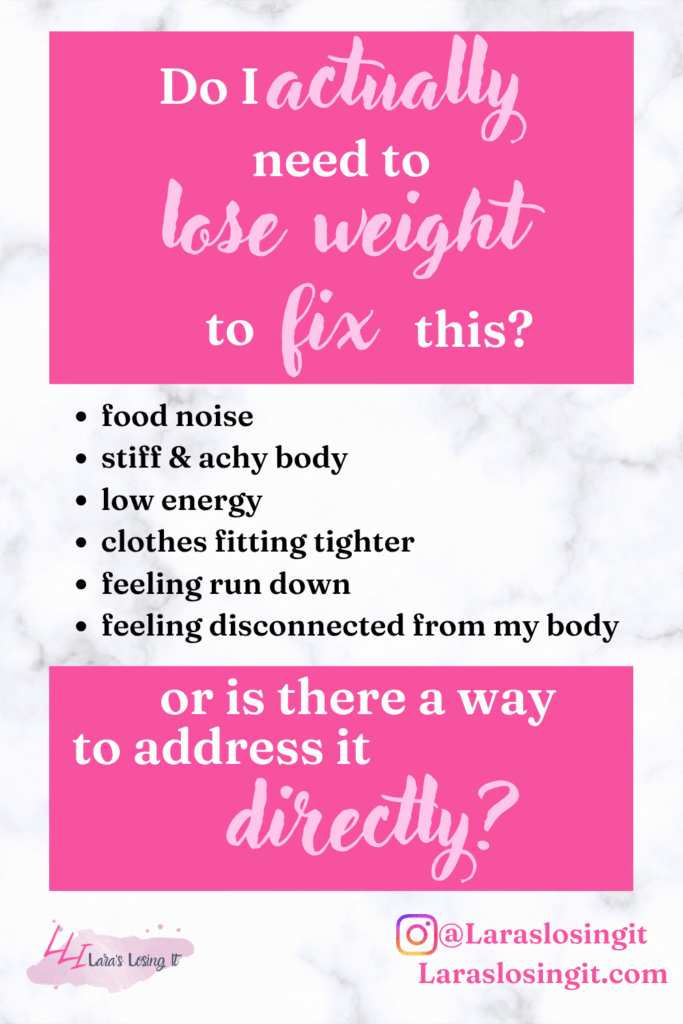
      I realized I was feeling stiff and achy. Some of my clothes had gotten tighter, which was physically uncomfortable. I felt run down, tired, fatigued. In general, I just didn’t feel very good in my body.

      And then came the question that changed the direction I was heading: do I actually need to lose weight to address those things?

      Of course the answer was no.

      I could address stiffness without making weight loss the goal. I could buy or wear clothes that fit my body comfortably now. Working on my energy levels, moving more regularly, and bringing gentle nutrition back into my life didn’t need to involve shrinking my body either. None of those things required me to make my body smaller the project.

      Do I actually need to lose weight to fix food noise, stiffness, low energy, or feeling disconnected from my body? Or is there a way to address it directly?

      What I Did Instead

      So that’s what I did.

      Moving My Body Again

      I started exercising again, but gently. There was no declaration that I was suddenly going to work out six days a week. Sometimes the goal was simply, “I’m going to move my body for 20 minutes today.” I returned to forms of movement I actually liked and wanted to do.

      Bringing Intuitive Eating Back Into the Picture

      I also started being more intentional with food again, not restrictive, not dieting, and not trying to earn or compensate for anything I ate.

      Instead, I started asking questions like, “How will this food make me feel?” “What have I eaten today?” “Would adding some fruit or vegetables feel good?” “Could I use some protein?” “Is there a snack I could have right now that would give me the energy and nourishment I’m looking for?”

      The chips didn’t become forbidden. The pizza didn’t become “bad.” The cookies didn’t need to disappear. I simply brought the rest of intuitive eating back into the picture.

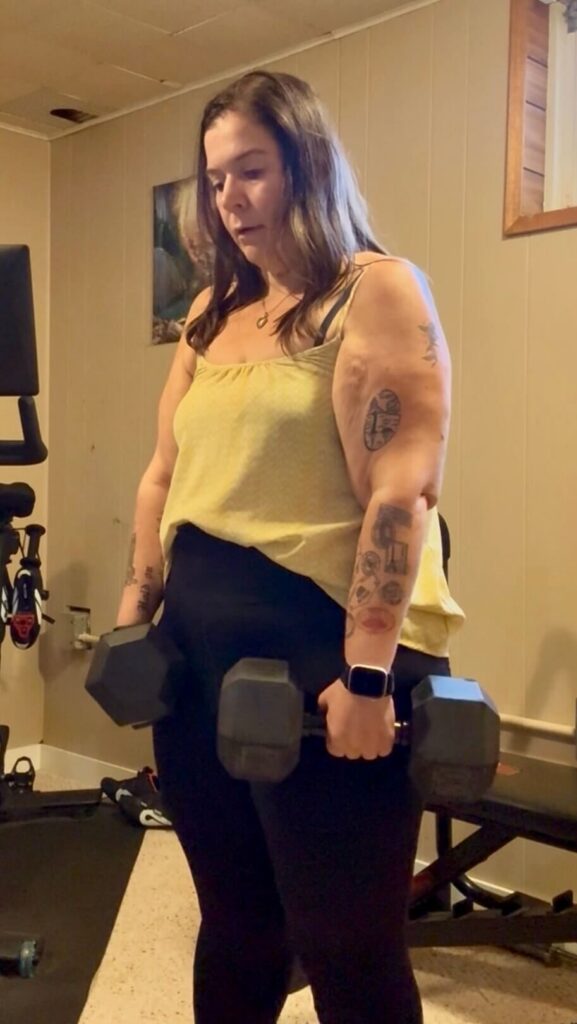
      Gentle movement at home with dumbbells, part of reconnecting with self-care without needing a GLP-1 for weight loss

      What Actually Changed

      And I started feeling better. My energy improved. Moving my body helped with how I physically felt. I felt more connected to myself and more intentional about caring for my body again. And the food noise? It got quiet, not because I forced it to, but because I was actually giving my body consistent, adequate food and attention again.

      I also ended up losing the weight I had gained, but that wasn’t the focus, and I think that distinction matters. The goal was never “how do I force my body back to the size it used to be?” The goal was “what am I actually uncomfortable with, and what would help?”

      For me, the answer wasn’t a GLP-1 medication. It was reconnecting with the habits and forms of self-care that made me feel good without turning my body into a problem that needed to be fixed.

      This Isn’t a Verdict on GLP-1s

      I want to be clear that this is my personal story, not an argument that nobody should take GLP-1 medications. These medications have medical uses, and someone’s decision to take one is between them and their healthcare provider. What I’m interested in is the pressure many of us can feel when weight loss becomes culturally available, visible, and seemingly expected again.

      Because if someone who had already spent years healing her relationship with food could find herself awake at night trying to convince herself to pursue weight loss again, I know I’m not the only one who’s felt that pull.

      If You’re Asking Yourself the Same Question

      Sometimes “I need to lose weight” is the first thought. It doesn’t necessarily have to be the final answer.

      There may be something underneath it: clothes that don’t fit comfortably, feeling sluggish, wanting more strength or mobility, feeling disconnected from your routines, comparing yourself with other people, or simply living in a culture that keeps telling you a smaller body would solve the discomfort.

      Before turning the desire for weight loss into an instruction, it can be worth getting curious about it. What am I actually feeling right now? What do I believe weight loss would change for me? And is there a way I can care for that need directly, without making my body smaller the prerequisite for feeling better?

      If this is a question you’re sitting with too, this is exactly the kind of work I do with coaching clients, getting underneath the “I need to lose weight” thought to find out what’s actually going on, and what would actually help.

      I’m also hosting a free live workshop on this exact topic. Save your spot here.

      And if food noise is the thing you’re mainly trying to quiet, my free 5-minute Emotional Eating Check-In Workbook is a good place to start noticing what’s actually driving it. Grab it here.

      FAQ: Quieting Food Noise Without a GLP-1

      Can you quiet food noise without a GLP-1?

      Yes, for many people. Food noise often gets louder due to restriction, stress, or disconnection from your body’s actual cues, not just from needing medication. Addressing those underlying causes (through consistent, adequate eating and gentle nutrition) can quiet food noise without a prescription.

      Do I need a GLP-1 to lose weight?

      Not necessarily. Weight loss can happen as a side effect of addressing what’s actually going on underneath the desire to lose weight, whether that’s low energy, discomfort, or disconnection from your routines, without making weight loss itself the goal. The key for a lot of people is to become more neutral about your weight. So, it’s no longer the focus or what you are trying to achieve.

      Is it normal to consider a GLP-1 even as an intuitive eater?

      Yes. Cultural pressure around weight loss doesn’t disappear just because you’ve healed your relationship with food. Even people with years of intuitive eating experience can feel pulled toward the GLP-1 conversation; it doesn’t mean anything went wrong.

      Are GLP-1 medications compatible with intuitive eating?

      That’s a personal medical decision between you and your healthcare provider, not something this post argues for or against. This post is specifically about the question underneath “should I take a GLP-1,” not a stance on the medication itself.


      Want more honest, real talk on ditching diet culture for good? Come follow along on Instagram @laraslosingit

    • Is Intuitive Eating Reserved for Thin People?

      I’ve noticed something about the intuitive eating space: the majority of intuitive eating coaches, nutritionists and dietitians I see working in this space are thin people. I just don’t see very many plus-size people doing this work.


      And it got me thinking about the message that sends.


      It can almost make it seem like intuitive eating is reserved for thin people. Like if you’re plus-size, or you naturally live in a bigger body, you can’t really be an intuitive eater, and you certainly can’t be an intuitive eating coach.


      There’s another message underneath that too: if you’ve really healed your relationship with food, found food freedom and become a fully intuitive eater, then eventually you’ll be thin.


      But that’s just not true.


      I’m plus size. I’ve been an intuitive eater for quite a number of years now. I haven’t dieted in a very long time. I’m in a really good place with my relationship with food and my body, and I eat mainly in a way that feels good and leaves me feeling good and energized.


      And I’m still plus size.


      I also think there are parts of intuitive eating that can be significantly more difficult when you live in a bigger body — especially rejecting the diet mentality and giving up the pursuit of weight loss.


      Because there is an immense amount of pressure put on plus-size people to lose weight.

      Constantly.


      It comes from society at large, social media, health and fitness messaging, and sometimes from people in our actual lives. If your body looks a certain way or you have a certain amount of body fat, the message is that you should be doing something about it. You should be losing weight. You should be “recomping.” You should be burning body fat.


      Naturally thin people simply don’t experience that particular pressure in the same way. So yes, I think rejecting the diet mentality can look very different when you’re doing it in a body that the world is constantly telling you should be smaller.


      There’s another part of my experience with intuitive eating that I don’t think gets talked about enough either.


      For me, intuitive eating still requires intention and mindfulness around food.


      I used to think that eventually I would get to this magical place where I wouldn’t really have to think about what I ate at all. I’d just eat whatever I wanted, whenever I wanted it, and somehow everything would naturally balance itself out.


      That’s kind of what I thought I was being sold when I first found intuitive eating.


      But that hasn’t been my experience.


      If I walk into a restaurant and look at a salad and a burger, let’s be real: I’m probably going to want the burger. I naturally gravitate toward highly palatable foods — burgers, pizza, chips, popcorn, cookies, fries. I like those foods. A lot.


      That doesn’t mean I can’t be an intuitive eater.


      It means that sometimes I bring a little more intention into the decision. I might ask myself: How is this meal going to make me feel later? How have I eaten today? Have I had many vegetables? Would adding some vegetables to dinner help me feel better? What actually sounds satisfying, and what is going to leave me feeling good afterward?


      That isn’t dieting. It isn’t food rules. And it isn’t trying to force myself to always choose the salad.


      It’s part of taking care of myself.


      Because if I give absolutely no thought to how I’m eating for a while, I know myself. I’m probably going to gravitate toward those highly palatable foods more often, and eventually I don’t feel very good physically.


      And I don’t think I’m the only person like this.


      I’m also not saying this is true of every plus-size person, just like I’m not saying every thin person naturally prefers salads and vegetables. Body size doesn’t tell us what somebody eats, what foods they prefer or what their relationship with food looks like.


      I’m talking about people like me… people who have a healthy appetite, genuinely love highly palatable foods, and don’t naturally find that every food decision magically “balances out” without any thought at all.


      Those people belong in intuitive eating too.


      Because intuitive eating is so often reduced to: “Eat when you’re hungry and stop when you’re full.”


      But those are basically two pieces of a ten-principle framework.


      There’s also satisfaction. There’s respecting your body. There’s movement. There’s gentle nutrition. There’s learning how different foods actually make you feel. There’s paying attention. There’s intention.


      And for me, that last part matters.


      The biggest difference since becoming an intuitive eater isn’t that I suddenly stopped loving pizza, burgers, chips or cookies. I didn’t.
      The difference is that I don’t tend to binge on them anymore.


      Do I occasionally eat past comfortable fullness because something is delicious and I want more of it? Absolutely. Sometimes highly palatable food is genuinely hard to stop eating.


      But I don’t have those out-of-body binge experiences I used to have when I was deep in dieting. Food doesn’t have that same power over me anymore.


      So maybe this is the part of intuitive eating we need to talk about more.


      You can have food freedom and still think about nutrition. You can eat intuitively and still be intentional about your choices. You can love burgers more than salads and still learn to eat in a way that makes your body feel good.


      And most importantly, you can become an intuitive eater, heal your relationship with food, reject dieting, and still be plus size.


      Thinness is not proof that intuitive eating “worked.” And being plus size is not proof that it didn’t.