
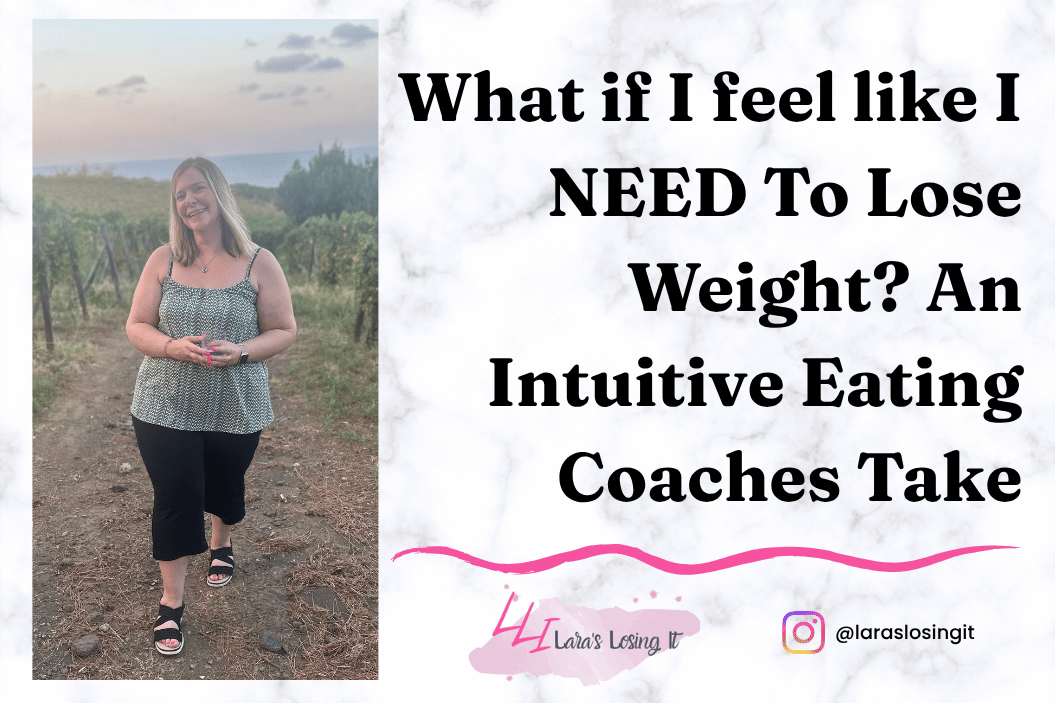
TL;DR: If you feel like you need to lose weight, start by asking what you’re actually hoping to fix. Then address that directly (health, comfort, pain relief) through behaviours, not the scale. Weight loss isn’t a behaviour; it rarely lasts in the long term, and you don’t need to know your weight to feel better.
I wanted to address one concern that comes up A LOT for people on the journey towards becoming an Intuitive Eater: what if I feel like I need to lose weight?
Some people feel that way after a doctor tells them they need to lose weight. Others feel this way because they’ve recently gained weight and they’re more uncomfortable now than they were when they were smaller, or they’re dealing with a health concern and/or physical pain that they feel losing weight would help with.
If you’ve recently gained weight, remind yourself that while, sure, your new larger body may feel different than it did when it was smaller, different is not necessarily bad or uncomfortable. Be aware of how you’re labelling your feelings in that regard.
So if this is something you’re navigating, here are the three questions I always come back to with my coaching clients when the urge to lose weight shows up.
Question 1: What Am I Really Hoping Weight Loss Will Give Me?
TL;DR: Improved health and comfort don’t need you to know your weight. Nutrient-rich food, movement that feels good, good sleep, and self-care get you there. Dealing with joint pain? Strengthen the muscles around it, instead of trying to lose weight.
The first thing to ask yourself if you feel this way is: what are you really hoping to gain from weight loss? On the surface, you may think it’s about improved health or comfort, but you can improve your health and comfort without ever knowing how much you weigh.
Weight loss is not a behaviour. You can do things like eat more nutrient-rich foods, move your body in ways that feel good on a regular basis, prioritize good sleep, practice self-care, etc, etc.- all of these things are health-promoting behaviours, and none of them have anything to do with what you weigh.
If you’re dealing with physical pain like joint pain, the best thing to do for that is to strengthen the muscles that connect to that joint. Visit a physical therapist if you can. Google “how to strengthen knees” or “how to alleviate knee pain” and you will find a lot of suggestions! Once again, you can work towards this without even knowing how much you weigh.
Question 2: What Would a Thin Person Do About This?
TL;DR: No health condition exists only in larger bodies – so ask what a thin person with the same issue would do, then do that! It’s the root cause that needs fixing, not your weight.
The second thing to ask yourself is – what would a thin person do about this particular issue or discomfort? Remember that no health condition exists solely in larger-bodied people. There just isn’t. So any health condition or physical pain that you’re dealing with right now – there are thin people out there who deal with and have dealt with that same thing.
So what is something that they would do? We covered some of this in question #1, but ultimately it comes down to actually addressing the cause of the problem and working to help that. Once again, your weight in and of itself is not causing anything.
Question 3: What Happened Last Time I Tried?
TL;DR: Intentional weight loss almost never sticks long-term. A well-known meta-analysis tracked people for 5 years after weight loss and found that the average person had regained nearly 80% of what they’d lost! So treating a health or comfort issue with weight loss is usually just a temporary fix.
Third – remind yourself of your previous attempts to lose weight and how they ended up in the long run. Contrary to what diet culture will try to tell you, your experience with gaining back weight that you previously lost is not unique. A meta-analysis that tracked people for years after intentional weight loss found that, on average, only 21% of the weight lost was still off at the 5-year mark, meaning the average person had regained close to 80% of what they’d lost. Remind yourself that intentional weight loss is one of the strongest predictors of future weight gain, so trying to treat anything by losing weight tends to be a temporary fix at best.
You Deserve to Feel Comfortable Right Now
TL;DR: Comfort doesn’t have to wait on weight loss! Well-fitting clothes you feel good in (even second-hand finds!) can fix that today. You deserve to feel comfortable no matter what the scale says.
Ultimately, remember that you do deserve to be comfortable! If your clothes aren’t fitting very well, get some new ones that are comfortable and look good! If you can’t afford new clothes, don’t be afraid to shop second hand – I personally buy most of my clothes second hand, and it is amazing what you can find!
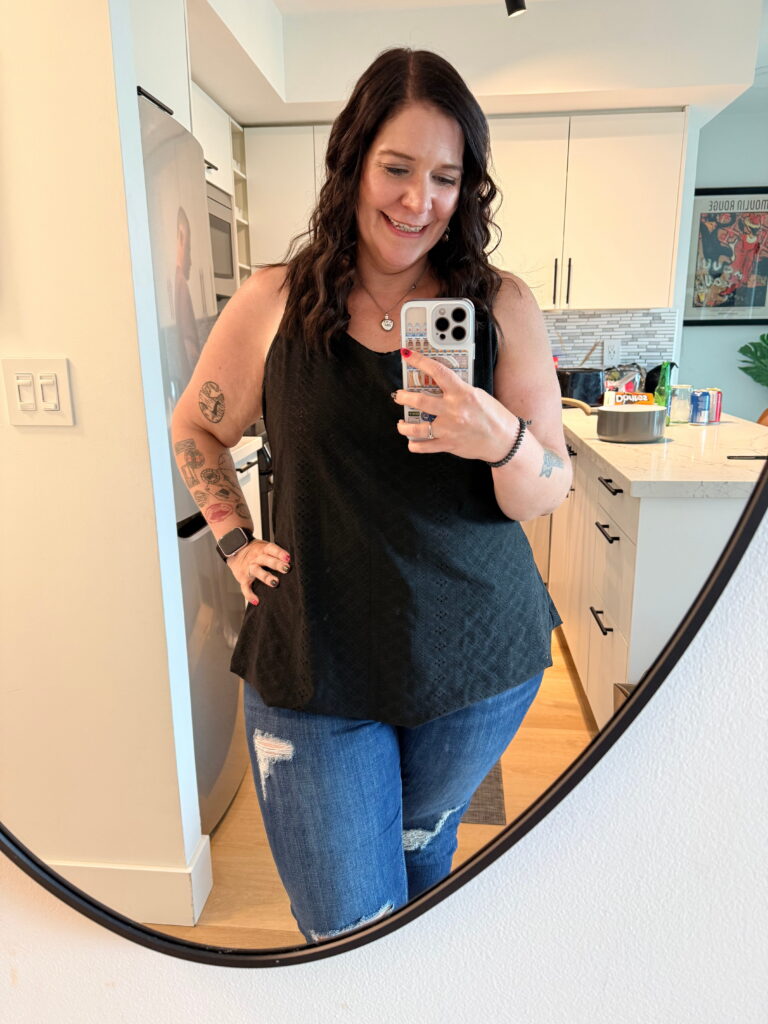
Your weight is not a problem that needs to be fixed. Society’s views of higher weights and larger bodies is the problem that needs to be fixed!
FAQ: Weight Loss, Health, and Intuitive Eating
Ask your doctor exactly which health marker they’re worried about, then ask what you can do about it directly! Most of the time there’s a behaviour you can work on (movement, sleep, nutrition, stress) that has nothing to do with the number on the scale.
Yes! Health comes from behaviours – how you eat, move, sleep, and handle stress – not a number on a scale. People with larger bodies have the same health outcomes as people with smaller bodies, and the same goes the other way.
Yes, most of it tends to come back over time. A meta-analysis of nearly 30 studies found that people maintained only about 23% of their initial weight loss on average 4 to 5 years later. That’s exactly why an intuitive eating, non-diet approach focuses on behaviours instead of the scale.
Go after the actual cause! For joint pain, that usually means strengthening the muscles around the joint (a physical therapist is amazing for this). Addressing the root of it works better and faster than weight loss ever would.
One Last Thing…
Let me know if this helped you at all! And if you’re not sure where you land with all of this, take my free Food Freedom Quiz to find out what’s really keeping you stuck.