Quick answer: Why do I binge eat at night? If you eat “perfectly” all day and then find yourself in the pantry at 9pm eating straight out of the bag, you’re not broken. And you’re not lacking willpower. Nighttime bingeing usually comes down to one of three things: under-eating during the day, stress, or a body still guarded from years of restriction. The fix isn’t more willpower at night. It’s addressing what happened earlier in the day.
Why do I binge eat at night – It’s not a willpower problem
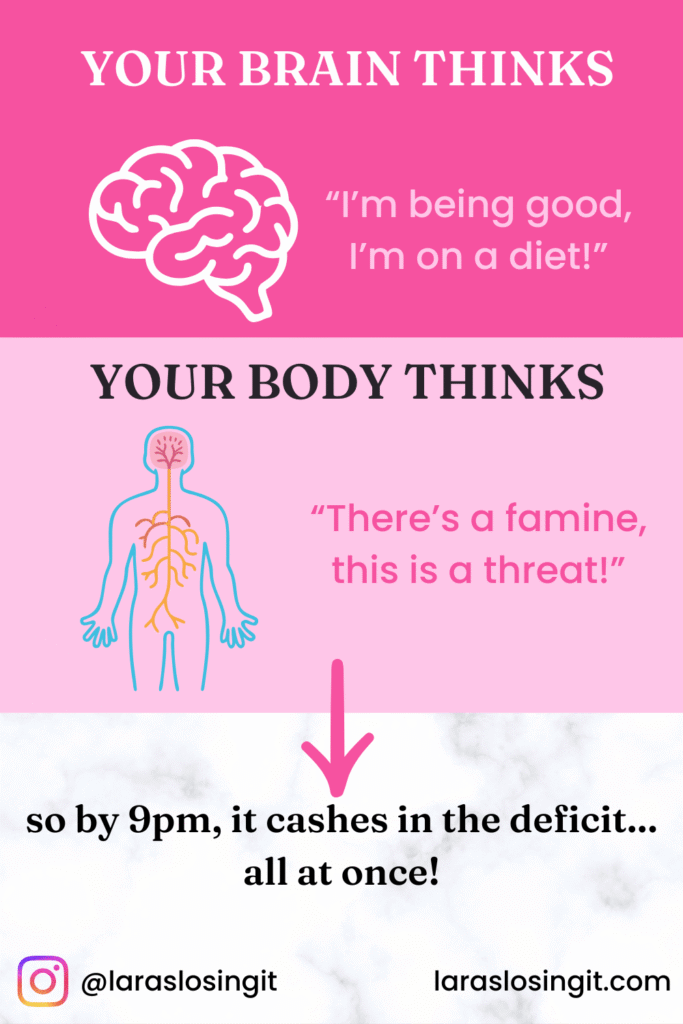
Quick answer: It’s not a willpower problem; it’s a supply and demand problem. Your body spends the day building up a deficit. By evening, when you’re naturally more exhausted and willpower (a finite resource, not a personality trait) has run out, your body cashes in that deficit all at once.
Here’s the thing that nobody tells you when you’re deep in diet culture: your body doesn’t know the difference between “I’m on a diet” and “there’s a famine.” It just knows it didn’t get enough, and it’s going to make sure it gets enough eventually… usually around 9 pm, standing in front of the open pantry.
Your Body Doesn’t Know “Diet” From “Famine”
If you under-eat during the day, skip meals, or white-knuckle your way through “being good,” your body spends all day building up a deficit. It doesn’t care about your calorie math or your intentions; it just registers that not enough came in. By the time evening rolls around and willpower has run out, that deficit gets cashed in all at once.
The 3 Most Common Causes of Nighttime Binge Eating
Quick answer: The three most common drivers are under-eating during the day, using food to process stress or emotions, and a body that’s learned, from years of restriction, to hold onto and grab food whenever it’s available.
1. You’re Under-Eating During the Day
If breakfast is coffee, lunch is “whatever’s fastest,” and you’re telling yourself you’re “saving calories” for later, you’re setting up a night of bingeing. Your body isn’t interested in your calorie math… it just knows it’s hungry.
2. You’re Using Food to Process the Day
Work stress, a hard conversation, the mental load of running a household… food can genuinely soothe in the moment. That’s not a character flaw; it’s one of the only tools a lot of us were ever given for emotional regulation. The problem isn’t that food comforts you. The problem is when it’s the only tool in the toolbox.
3. Years of Restriction Have Taught Your Body Not to Trust You
If you’ve dieted on and off for a long time, your body has learned that food isn’t always reliably available. That makes it hold on tighter and grab more when it is available, even if you’re not currently restricting. This isn’t something you can think your way out of overnight… it takes consistent, adequate eating over time to teach your body it can trust you again.
What Actually Helps
Quick answer: Eat enough, earlier in the day. Build in a check-in before you judge what’s happening at night. And find at least one non-food way to come down from the day, so food isn’t the only tool available.
Eat enough, earlier. This sounds almost too simple, but it’s the single highest-leverage change most people can make. That means real meals with actual volume, not just snacks stacked on top of each other. If dinner is a salad and a granola bar, your 9 pm self won’t be satisfied with “just a little something.”
Build in a check-in before you decide anything about the binge. Before you judge what’s happening at night, ask: did I eat enough today? Often the honest answer is no, and that reframes the whole moment from “I have no control” to “my body is asking for what I didn’t give it earlier.”
If this pattern feels familiar, I built a free 5-minute Emotional Eating Check-In Guide to help you start noticing what’s actually driving it. Before you’re on autopilot reaching for food. Grab it here.
Find one non-food way to come down from the day, even a small one. This isn’t about replacing food with some elaborate self-care routine. It can be as small as five minutes in the car before you walk in the door, or as simple as texting a friend instead of going straight to the kitchen. The goal isn’t to never turn to food for comfort again… it’s to have more than one option.
This Isn’t Something You Fix in One Night
If you’re in this pattern right now, please know: one binge, or even a stretch of them, doesn’t undo progress or mean you’re back at square one. It means your body is telling you something… usually that it didn’t get enough earlier, or that today was a lot to carry. The goal isn’t perfect eating. It’s building enough trust with your body over time that food stops feeling like something you have to control or escape from.
This is exactly the work I do with coaching clients – untangling the difference between a body that’s genuinely hungry and a nervous system that’s overwhelmed, and building a relationship with food that doesn’t depend on willpower at all.
Not sure which pattern is driving your eating? Take my free 2-minute quiz – What’s REALLY Keeping You From Food Freedom? to find your starting point.
FAQ: Why Do I Binge Eat at Night?
“Healthy” and “enough” aren’t the same thing. If your meals are light on volume or you’re skipping/delaying eating to “save room,” your body can build a deficit all day even while eating foods you’d consider healthy… and it cashes that deficit in at night.
Occasional nighttime bingeing after an under-fueled day is common and usually resolves by eating enough, earlier. If it’s happening frequently, involves a strong sense of losing control, or is affecting your physical or mental health, it’s worth talking to a doctor or therapist… this post covers the common, restriction-driven pattern, not clinical binge eating disorder.
Start by naming it – noticing when you’re reaching for food to soothe stress rather than out of hunger. From there, build in one non-food way to decompress (even five minutes), so food isn’t the only option available when stress hits.
Yes. Any pattern of under-eating – skipping meals, delaying food, “saving calories” – sends the same signal to your body regardless of whether you’d call it a diet. Years of that pattern can also condition your body to hold on tighter to food long after the restriction itself has stopped.
If this pattern feels familiar, come follow along on Instagram @laraslosingit for more real talk on ditching diet culture for good.