Quick answer: Run any program through this is-it-a-diet checklist: food rules, restricted foods or food groups, “allowed” quantities of anything, or a weight-loss-first goal are all red flags. If any one of those is present, it’s a diet… no matter how they brand it. The real test isn’t the marketing. It’s about whether the plan is teaching you to trust and listen to your own body, or to override it.
“Anti-Diet” Is Everywhere Now… But Is It Real?
Back in 2019, when I first started writing about this, “anti-diet” was just becoming a buzzword. Now, in 2026, it’s no longer a niche philosophy… It’s a full-blown marketing category. Every corner of wellness culture has caught on: coaches, influencers, even some dietitians, are dropping the word “diet” and replacing it with “protocol,” “reset,” “lifestyle,” or “metabolic rebalance.” Meanwhile, GLP-1 drugs have pulled weight loss culture in a totally different direction, and a wave of “food noise” and “soft dieting” content has popped up to fill the gap for people who don’t want a prescription but still want the diet mentality dressed up in gentler language.
Here’s my honest opinion, unchanged since 2019: rebranding a diet doesn’t make it not a diet. If a program is handing you rules about food, it’s a diet… even if the word “diet” never appears once in their marketing copy.
So how do you actually tell the difference between real food freedom and a disguised diet? Here are the checkpoints I use and the same ones that I walk my coaching clients through.
The Is-It-A-Diet Checklist: 5 Red Flags to Watch For
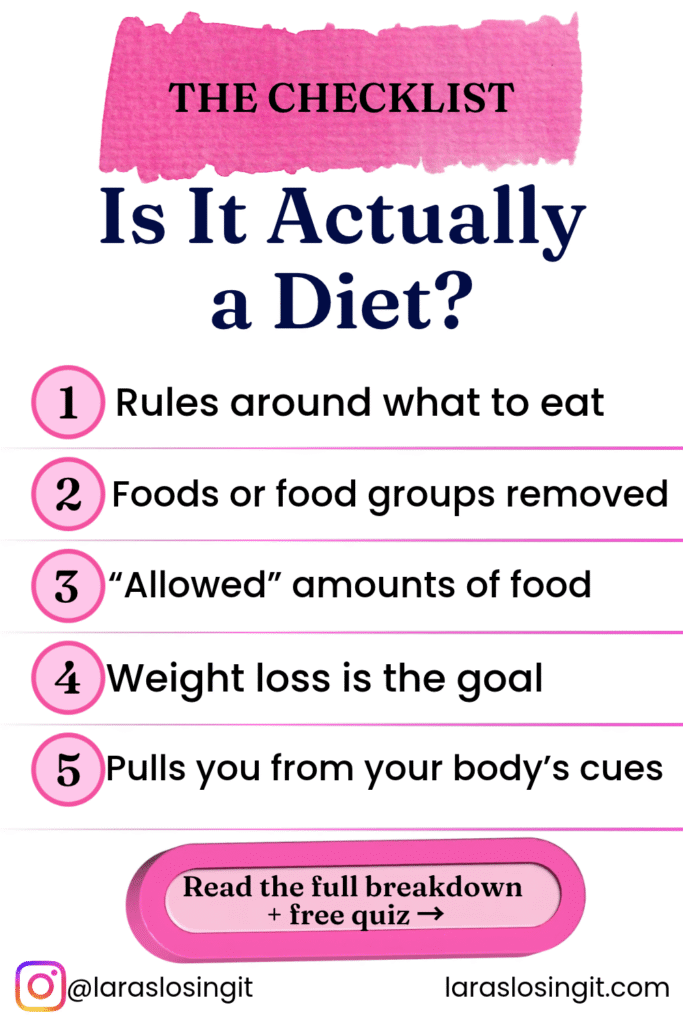
Quick answer: Watch for food rules, eliminated foods or food groups, “allowed amounts” of anything, a weight-loss-first framing, or any instruction that pulls your attention away from your own hunger and fullness cues.
1. There Are Rules Around What to Eat
Portion sizes, “acceptable” food lists, specific gram or calorie targets, macros to hit… if there’s a rulebook, it’s a diet. Doesn’t matter if it’s dressed up as “intuitive macros” or a “flexible framework.” A rule is a rule.
2. You’re Told to Remove Foods or Food Groups
Can’t eat sugar. No carbs, no dairy, no “ultra-processed” foods, no seed oils, no gluten unless medically necessary. If a program is asking you to eliminate entire categories of food without a genuine medical reason, that’s restriction… and restriction is the engine that drives every diet, whatever it’s called.
3. There’s a “But You Can Still Have It… With Conditions” Clause
This one’s sneaky, and it’s everywhere in 2026’s wellness-washed diet culture. “It’s not a diet, you can totally have chocolate!” …as long as it’s 1 oz of 90% dark chocolate, eaten before 3 pm, on a day you “earned” it. That’s not food freedom. That’s a diet with better PR.
4. Weight Loss Is the Headline
If the program leads with weight loss… even softened into “sustainable fat loss,” “body recomposition,” or “hormone balance for a leaner you,” it’s a diet. Food freedom doesn’t sell itself on the scale.
5. It Pulls You Away From Listening to Your Body
This is the real litmus test, and it covers everything the first four points are really pointing at. If any part of a program takes your attention away from your own hunger, fullness, cravings, and satisfaction and puts it on an external rule instead, it’s a diet, full stop.
Why Your Body Already Knows What It Needs
Here’s the thing I still believe, seven years and a lot of client conversations later: your body is extremely intelligent. When you learn to trust it, and it learns it can trust you, it will tell you exactly what it needs and when. It’ll tell you which foods it doesn’t love in big quantities, and which ones it genuinely thrives on.
Weighing yourself. Counting calories, carbs, or points. Diligently following someone else’s meal plan, even a “gentle” or “intuitive” one. All of it distracts you from the one source of information that actually matters: your own body.
I’ve coached people through every single one of the patterns above… the Friday “treat day” that spirals into a weekend write-off, the all-or-nothing thinking, the constant food “shoulding,” the reaching for food as the only tool in the emotional toolbox. A better rule doesn’t fix any of those patterns. Rebuilding trust with your body does.

Curious which pattern actually sounds like you? I built a free 2-minute quiz, What’s REALLY Keeping You From Food Freedom?, that sorts you into one of four patterns (Restrict-Rebound, All-or-Nothing, Food Rules, or Emotional Eating) and gives you a starting point that’s actually built for how you eat, not a generic plan.
How to Actually Stop Dieting (Without Just Starting a New One)
Quick answer: Ditch the scale, stop outsourcing your food decisions to someone else’s plan, and start rebuilding the habit of checking in with your own hunger, fullness, and cravings before you check in with a rule.
A few starting points:
- Get rid of the scale, or at least stop stepping on it daily. It can’t tell you anything your body isn’t already telling you more accurately.
- Notice when you’re about to follow a rule instead of a body cue… that pause is where the real work happens.
- Practice naming hunger and fullness in the moment, even before you’re sure you’re “doing it right.” It’s a skill, and skills take reps.
- If stress-eating or emotional eating is your go-to, don’t try to white-knuckle your way out of it. That pattern needs a replacement tool, not just willpower.
If emotional eating hits home, I put together a free 5-minute Emotional Eating Check-In Guide… a simple, judgment-free way to pause and ask what you actually need in the moment before you’re on autopilot and reaching for food. Grab it here.
FAQ: How Do I Know If It’s a Diet?
Run it through the is-it-a-diet checklist above: food rules, eliminated foods or food groups, “allowed” amounts of anything, or a weight-loss-first focus. If any of those show up, it’s a diet, regardless of what it’s called.
No, genuine intuitive eating has no food rules, no restricted foods, and no weight-loss goal. If a program calling itself “intuitive eating” includes any of those things, it’s not actually intuitive eating; it’s a diet using the term as a rebrand.
No. Asking you to eliminate specific foods or food groups without a genuine medical reason is restriction, which is the defining feature of a diet… regardless of what the program calls itself.
A preference comes from your own body noticing how a food makes you feel and choosing accordingly. A rule comes from an external source telling you what’s allowed before you’ve had the chance to notice anything yourself.
That’s a separate conversation from what this post covers. GLP-1s are a medical intervention, not a food philosophy. But the “soft dieting” and food-rule-heavy content marketed alongside them often follows the exact same red-flag pattern above.
Want more of this kind of straight talk on ditching diet culture for good? I’m back on Instagram @laraslosingit — come say hi and follow along.